
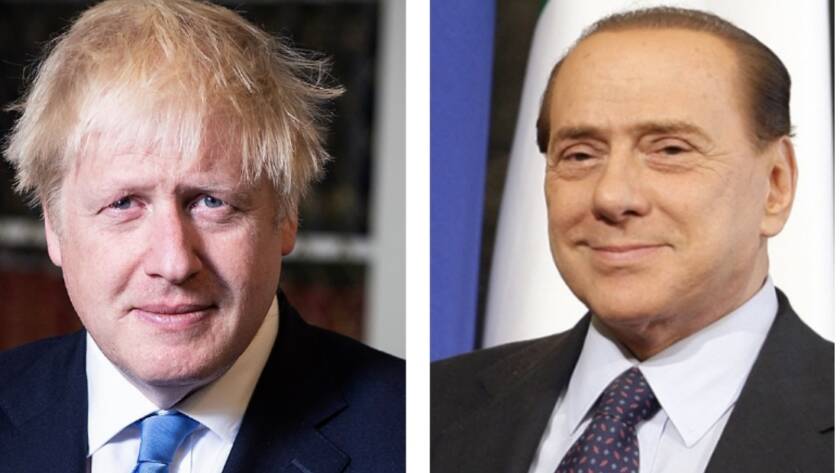
Mid-June saw the departure of 2 dominant politicians and 1 make the same sort of dangerous mistakes.
The first was Silvio Berlusconi. Much like Boris he presented himself as a disruptor, there to shake up the system for the people’s benefit. This was a big fat lie. Berlusconi was a product of the sleazy clientilismo embedded in Italian politics since WW2. It was how he made his money; its collapse as a result of ferocious magistrates threatened his gains. He lost his protector in the anti-corruption trials and went into politics for one reason only: to protect his personal interests. His great skill – like Boris – was to persuade voters that he was there to help them. He wasn’t; he didn’t. Despite Italian voters’ desperation for change, Berlusconi squandered the best opportunity Italy had to make reforms to its economy and politics. Worse: he sought to undermine those bodies, laws and structures which sustain democracy and good governance, both public and private. The years since have been a carousel of externally imposed unelected technocrats and implausible and ineffective populists. It’s a country that survives despite its political class but which could be so much more if the public realm and those in charge of it at least tried to act with competence and integrity.
So to Boris. In July 2020 I wrote this: “Johnson likes to be loved but he likes being feared even more. This can get you far in politics, indeed had got him to the top. When that loves fades and the fear goes – and they will, one day – his fall will be worth watching.”
Indeed it has.
The scathing Privileges Committee report – scathing about his lies, his contempt for Parliament, for the process, for the very idea of being held to account – is the inevitable consequence for a man who lied as easily as he breathed. What is worse is the way he – and his supporters – sought to undermine the very process which found him to have misled Parliament. This has gone beyond a simple disagreement with the outcome. Tribunals, committees, judges can get things wrong. Sometimes a decision depends on a difficult finely balanced judgment with which others may legitimately disagree. There are appeals processes. But, ultimately, once the process has been concluded you have to accept it. The tantrum of Boris and co., is not the cry of someone claiming a miscarriage of justice with evidence to support this. It is the wail of a man who thinks he simply should not be held to any sort of account at all, who thinks processes and procedures standing in his way simply do not matter, should be ignored, attacked and undermined, a man who does not understand the harm this does to democracy.
It is not just elections which make a country democratic: it is also the structures and processes in place which subject rulers to the law, hold them to account, establish independent bodies and systems of investigation and justice, understand the vital importance of separation of powers, make it clear that the system is bigger than any one party, any one politician, value integrity and trust and seek to embed these in its governance. It is the job of all democratic politicians to pass those structures and processes on in good order for those coming after, to realise that they are not owners but custodians, that they are – as John Nott was bluntly told – “here today, gone tomorrow” politicians and that our democracy, our state and the means by which they work – or try to – with some level of competence, trust and integrity matter far more than they do.
Boris understands none of this. Nor do his supporters. In attacking the Committee, they are harming the democracy and country they claim to love. They are treating it with the same disdain that Berlusconi exhibited in Italy. They do so because they value Boris’s personal interests more than anything else. It is what happens when a party becomes dominated by one outsize personality and thinks the party and leader are one. Pretty soon it starts to think the party, leader and state are also all one – and saying otherwise is lèse-majesté. There is more than a hint of this in the reaction to the Committee’s report. It is one of the best reasons why the Tory party needs to go into opposition – to remind itself that its interests and the country’s are not automatically one and the same, that how its leader and MPs behave matters.
So to Scotland where Humza Yousaf has, bizarrely, told his MSPs that they must stand behind Nicola Sturgeon or leave the party. What on earth is he thinking? Is he thinking? Police Scotland arrested and questioned Ms Sturgeon (a once dominant politician in the SNP and Scotland) because they had “reasonable grounds for suspecting” she had committed a criminal offence – see S.1(1) of the Criminal Justice (Scotland) Act 2016. She was not questioned simply to make her evidence admissible. That is a pretty serious state of affairs. Ms Sturgeon has not been charged; she may never be and, even if she is, is entitled to the presumption of innocence. Nonetheless, this is a live independent investigation into potentially serious offences. The FM should not be commenting at all. He should not be demanding his MSPs stand behind their former leader or leave. This should not be some sort of “If you’re not with me, you’re against me” test. It risks putting pressure on the police, especially one which has just appointed its new leader and in a country where the SNP is so dominant. For now, anyway. Above all, it creates the impression that he does not understand the value of an independent investigation by an independent police force nor the need for the FM to be scrupulously neutral and not be seen to be taking sides. The SNP should be more than one politician. It is no answer to say, as Mr Yousaf has done, that he was trying to rally all his party around independence. Ends and means, Mr Yousaf. This is the same excuse Boris is giving: he’s being attacked over Brexit. To protect it , he must not be attacked. This is laughable l’état, c’est moi territory and it demeans the politicians and parties talking like this.
Starmer is doubtless watching with glee. He should be careful. His decision to elevate Tom Watson to the legislature was a serious misjudgment, especially for an ex-DPP. Nominating someone who sought to manipulate the criminal justice system and the police for party political ends was shameful. We must hope that he does not make similar misjudgments in future. If he becomes PM there is plenty to repair in Britain. Not least of those is our democratic polity which has been so damaged by the current government. It is not constitutional change which is primarily needed but the understanding – followed by action – that trust, integrity and good judgment must govern the actions of everyone from the PM down. It may not be top of voters’ day to day concerns but, as the example of Italy shows: if the structure of the state is rotten and untrustworthy, if those in charge of it are untrustworthy and behave badly, then a country and its people will achieve less than otherwise. Britain can no longer afford the luxury of selfish, untrustworthy, thoughtless politicians.