Skip to content Skip to sidebar Skip to footer

This is what a “toxic” debate looks like

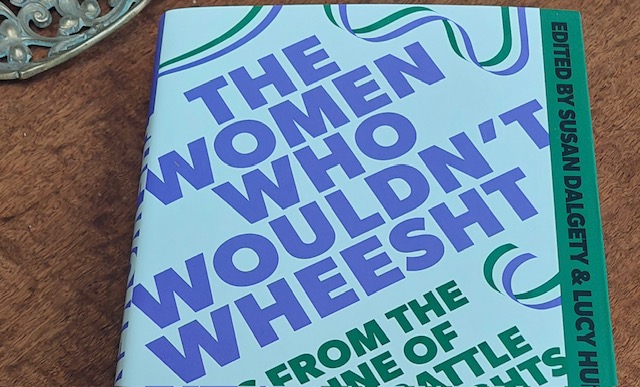
If you want to understand (and you really should want to) how gender ideology – the belief that men can turn into women simply by saying so based on some internal feeling they have – captured so many public institutions and members of the political class in recent years, how, in particular, it led to the disastrous Gender Recognition Reform Act in Scotland (blocked by the UK government), how Scottish women mobilised and fought back against it and the price they paid – and are still paying – for doing so, you should read “The Woman Who Wouldn’t Wheesht“, edited by Lucy Hunter Blackburn and Susan Dalgety. It tells the story of some of the very many women involved in the campaign to stand up for women’s rights, is well-written, infuriating, inspiring and so very very necessary.

But if you do not have the time, this tweet by Michael Cashman (Lord Cashman for he was made a peer in 2014 and takes the Labour whip) about Rosie Duffield, the Labour candidate for Canterbury, sums up all many of the worst aspects of the trans activists’ cause and the abuse and dismissal women face. 

Some facts:-

  • Michael Cashman is an outspoken spokesperson for trans rights, in particular the push for self-ID. He is entitled to do this and, it goes without saying, should not be attacked or threatened for having or expressing such views, however much one may disagree.
  • Rosie Duffield, an MP since 2017, has been an equally outspoken spokesperson for women’s rights and against the push for self-ID because of its effects on those rights. It also goes without saying that she should not be attacked or threatened for having or expressing such views.
  • Alas, that has not been the case. She has repeatedly faced considerable abuse and threats of violence for articulating those views.
  • This month Glen Mullen, 31, was convicted on two counts of publishing articles on ‘X’ threatening to kill Rosie Duffield and JK Rowling. He was given two suspended sentences. Quite why threats to kill women in the public eye should merit such light sentences is for another time.
  • Rosie Duffield has faced other repeated threats of violence and abuse. She had to avoid the Labour Party conference in autumn 2021 on police advice because of online threats from pro-transgender campaigners.
  • On 14 June she announced that she would be cancelling public hustings in her constituency because of continuing threats to her which she said in her statement were “being pursued with a new vigour during this election“. She said she would hold secure local events instead and has spent £2,000 on bodyguards to protect her while campaigning.
  • Michael Cashman’s response to this was to write on ‘X’ “Frit. Or lazy.”

On June 15th. Just one day short of 8 years to the day since a female Labour MP, Jo Cox, was murdered by a far right extremist, Thomas Mair, in what was described by the judge as an act of terrorism. One other MP, David Amess, was murdered in October 2021, also by a terrorist, Ali Harbi Ali, an IS fanatic. Stephen Timms survived an attempt to murder him in 2010 by Roshonara Choudhry, an Al-Qaeda sympathiser.

After all these attacks, Parliamentarians solemnly intone the vital importance of not attacking MPs for doing their jobs, of the need to realise that violence – or threats of it – are not the answer to differences of opinion, of the need be careful not to excuse or incite or be seen to be condoning violence against opponents.

None of this seems to have troubled Lord Cashman. Though the reaction to his message has, as he has now withdrawn his most recent message about Ms Duffield.
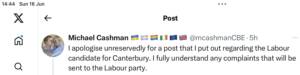
 

His sneering dismissal of the threats to Ms Duffield, his mockery of how she might feel, his lack of concern for the particular fears women feel when threatened by men, his disregard for basic civility in his withdrawal of the message, which did not even bother to mention her name and his focus on him understanding “any complaints sent to the Labour party” sums up both the narcissism of too many of those arguing the trans cause and the total failure to understand that it is precisely this sort of behaviour which shows – better than any argument – why women need women-only spaces for their safety, their dignity, their privacy. It shows the bullying nature of the cause he has adopted, its utter refusal to take into account any views other than its own and its determination to put women back in their box, in as contemptuous a way as possible.

If this is how a peer behaves, little wonder that masked youths feel emboldened to behave in the way they do whenever women seek to gather to speak about themselves and what concerns them. It does not just happen to women politicians. It happened at the FILIA Conference in Glasgow last October. It happened at a Women in Education Conference in London in February earlier that year. It happened at a conference by the Clinical Advisory Network on Sex and Gender in March of this year.

If women won’t shut up – or wheesht – voluntarily, they must be made to. That too was the message of an earlier tweet by Michael Cashman telling Ms Duffield to withdraw as candidate if she would not attend public hustings. How very de haut en bas of him: a man who does not need to bother meeting with constituents or seek their approval or face their disapproval, however unpleasantly expressed, blessed as he is with an unelected seat in Parliament for life. That message is still up. It does not matter if he now withdraws it. We know what he really thinks.

Little wonder too that it should be a Labour representative behaving in such a way. Labour has made much of its campaign to advance trans rights over the years. It has ignored the clash of rights and sought to pretend that this does not exist, despite the courts ruling on various occasions that there is such a clash. It has preferred to listen to only one side of the argument. It has refused Labour Women’s Declaration access to its conference to argue their case. It has turned a blind eye to the abuse women have faced. Its manifesto says more on the topic of gender (106 words) than on women’s rights (61 words). Women’s need for single sex exceptions in the Equality Act are mentioned right at the end of the section headed “Respect and Equality for All” (26 words), almost as if they are an afterthought. It ignores the recommendations of the EHRC to clarify the meaning of “sex” in the Equality Act, so as to preserve those exceptions. It has said nothing in response to this being one of the 11 points listed by Mumsnet in its document setting out what matters to women. It prefers instead to claim that this is purely a Tory “culture war” while failing to realise that ignoring the very real legal and material issues involved is itself a form of “culture war“.

Wes Streeting, the Shadow Health Secretary, said in July 2023 that he was “really sorry about the way Rosie’s been treated” over this issue. It was a rare – and welcome (if some might consider it opportunistic) – acknowledgement by a senior Labour politician of the toxicity of the debate, its effect on women and that the Labour Party might actually need to think a bit harder about this topic.

The Labour leader has not been so forthcoming. When Ms Duffield had to withdraw from the Labour Conference, it was the Commons Speaker, Lindsay Hoyle, who spoke up to say that MPs should not be attacked or threatened for doing their job. Good for him. But why has Starmer been silent on this, even when it it has been one of his own MPs threatened? If Streeting can see this and speak up, why can’t Starmer? Why won’t he?

Yesterday, the Labour leader issued this message on ‘X’ remembering Jo Cox.
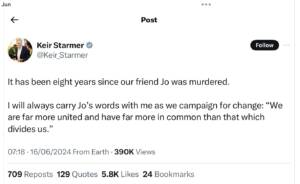
Fine sentiments.

He also said last week in an interview with HuffPost that people are “exhausted” by political battles over issues such as trans rights. Half right. It is not a battle about trans rights. It is about women’s rights and women are indeed exhausted at having to fight to keep rights they fought hard to obtain. They are exhausted and furious, as Ms Dalgety and Ms Blackburn’s book explains, at having to explain over and over again why women’s rights matter, at having to do this in Parliament, in Holyrood, on the streets, in the media and in endless legal cases they have to fund themselves and against a background of abuse, insults and threats of violence. And, above all, at not being listened to or being patronised or told that they don’t know their own mind or are being manipulated and all the rest of the “yes dear, stop bothering the men with these fringe issues” brush-offs. If he does indeed want to end this exhaustion and bring people together, he would do well to listen – really listen – to what women have to say.

If he has time to issue messages about what happened 8 years ago, he surely has time to do and say something about the current issue, to stand unequivocally behind this female MP, to reassure women that he will stand by them when they speak up about their concerns and remind Michael Cashman and those thinking like him that bullying and turning a blind eye to threats of violence should not – and will not – have any place in the Labour Party or this country. 

Will he?


View comments

The Government’s Role

Part Three

This scandal was not an unfortunate consequence of stodgy processes, ill-informed incompetent executives and a blind faith in a flawed IT system. Post Office staff did not behave the way they did just for the hell of it. They did so because they believed this was what was wanted by the government, its owner. It was the government which set its “strategic parameters” while remaining at arm’s length from its day-to-day operations. 

I wrote here about one key question which remains to be answered in relation to the cover up and the Post Office’s conduct over the Bates litigation: What did the government know? When did it know it?

But there is another important question which needs asking first.

To what extent did the government’s strategic priorities for Royal Mail and the Post Office lead to the scandal? 

Last week’s evidence from Paula Vennells shed some light on one aspect of this: the 2013 IPO of Royal Mail and her curious intervention, the one which according to her self-appraisal “really earned her keep”.

Royal Mail had been loss-making for years: governments, whatever their political persuasion, were determined to make it more commercial, perhaps even profitable and, eventually, to privatise what could be privatised. The Post Office needed to widen the range of products it sold, with financial products its preferred option. It also needed to reduce costs. These were the priorities. Any sort of admission that IT systems were not fit for purpose, might need more (expensive) investment risked derailing this. It also partly explains why no-one inquired too closely into how Post Office investigators actually behaved. Rather than being a genuine investigations team, they were a debt collection team collecting monies which the Post Office wrongly thought it was owed. There was no incentive to look closely at whether they were complying with the law, actually investigating the reasons for the discrepancies, or abusing their powers. The incentives went the other way.

Once privatisation was on the agenda, this became even more important. Ensuring the Royal Mail was attractive enough to be sold – profitably – and splitting the Post Office into a separate stand-alone company were the focus. Achieving this while while ensuring that its day-to-day business and backroom functions are being run as they should be is a challenging task, even in the best run company. Not even its best friends would describe the Post Office thus.

The Royal Mail IPO

The 2013 prospectus for Royal Mail’s IPO contains a section dealing with its relationship with Post Office Limited (“POL”) and the material risks this exposed Royal Mail Group to – para. 1.18. It mentions dependance on the “effective operation of POL’s IT systems and processes and on the public perception of Royal Mail and POL as one entity. “Any business or commercial decisions taken by POL could therefore be perceived as decisions taken by…. the Group and adversely affect the reputation and brand of the Group……Any failure in POL’s IT … systems …. may lead to adverse publicity and adversely affect the reputation and brand of the Group.

What this section or the prospectus as a whole nowhere mentions is POL’s prosecutorial role during the period when it and Royal Mail were one entity. Nothing was said about any ongoing responsibilities for (a) any failings in prosecutions carried out pre-IPO and/or (b) any obligations to pay compensation.

Ancient, irrelevant history? No. By mid-2013 there were credible concerns about POL’s IT systems, the safety of past prosecutions and possible liability for compensation. POL’s insurers had been notified. Any prospective investor in Royal Mail would surely have wanted to know about risks arising from past conduct by Royal Mail (including whether these had clearly been carved out) as well as ongoing risks relating to a future long-term business partner. Those drafting the prospectus certainly thought so because something was put in about the Horizon system.

On her last day giving evidence, Paula Vennells stated that she had managed to remove references to Horizon from the Royal Mail prospectus. According to her, it was irrelevant and damaging to POL. She repeated that she had played no role at all in the prospectus or the IPO so it is odd how she was able to assess the possible relevance of certain statements. Perhaps an understanding of regulatory obligations and listing rules was one of her hidden talents.

What was it she was so keen to remove because it was so damaging and irrelevant? It was the statement which POL had proudly trumpeted in its press releases following the interim Second Sight review to show that subpostmaster allegations and concerns were exaggerated and unjustified.

In July 2013 an interim report was published into alleged problem’s with POL’s “Horizon” computer system which is used to record transactions in its branch network. The report confirmed that no system wide problems had been found in relation to the “Horizon” software, but suggests that POL should examine its support and training processes for Sub-Postmasters.” 

How could POL’s own press release be damaging? Two reasons: the reality behind the review and the other advice which POL had received made this statement “economical with the truth“. If this thread had been pulled, if questions had been asked, who knows where these might have led? Had there been even the merest hint of possible miscarriages of justice arising from matters taking place during the period when Royal Mail was in charge, how would this have affected Royal Mail’s sale? The question answers itself. 

More questions, then –

  • What exactly did she say to persuade those who drafted the prospectus to remove statements they clearly thought necessary? How accurate and evidence-based was it?
  • Was this discussed by the Royal Mail Board? By the POL Board? With the Business Department? With the Treasury? With Ministers? With the underwriters and advisors? 
  • Were there discussions, arrangements, legal agreements regarding any ongoing responsibility for such matters? 
  • Who – and at what level – signed off? 

And so on. 

The Arbuthnot Test

It was Lord Arbuthnot who in his evidence pointed out the problem with the government’s arm’s length approach to POL. Where there was only one shareholder – the state – refusing to get involved in operational matters, even when such matters had gone badly wrong, there was a lack of democratic accountability. What sort of effective governance can you have of a state owned body which faces neither the discipline or scrutiny of the market nor effective democratic accountability through Ministers?

It is a good question. We have yet to receive a good answer.

Arm’s length?

But was the government that arm’s length in reality? There was some evidence that one of the non-executive directors, Richard Callard, representing the government, was closely interested in how POL responded to adverse press coverage, which doesn’t sound particularly hands off. The two other shareholder representatives, Susannah Storey and Tom Cooper, have yet to give evidence. What they say will merit close attention.

The government’s reaction to this scandal has been curious and surprisingly similar to Ms Vennells’ unconvincing response to a key question put by Jason Beer KC. He pointed out that if, for years, she had been told by staff that all was well with Horizon, it seemed odd that she was so insouciant when finally told that there were some serious problems with it and that these affected past and existing prosecutions. Why wasn’t she more shocked? Why didn’t she demand answers about how this could possibly have happened? Why didn’t she ask why she had not been properly briefed? Ms Vennells hand waved it all away by saying it was all historic and had now been fixed. But her reaction at the time was more instructive: it was consistent with someone who had known all along but was reliant on the measures taken to keep this knowledge to as few people as possible. 

When Sir Wyn asked her why the briefing for her appearance before the Business Select Committee in 2015 was “very precise, very circumspect, very guarded” she had no answer (see here). In agreeing so easily that this was the intended effect of the briefing prepared for her, she had not thought through the implications of why her staff believed she ought to be briefed in such a way.

It was a telling moment.

The government’s reaction

Much the same could be said about the government’s response. If POL was a rogue organisation which for the best part of two decades had misbehaved, misled the government and the courts and wasted money on pointless litigation, you’d expect the government to be furious when it finally discovered this in 2019. After all, the Common Issues judgment severely criticised the PO’s behaviour in the litigation, its witnesses’ credibility and honesty (with one witness referred to the DPP for possible perjury) and its mistaken belief in Horizon’s integrity. It was not so much a mistaken belief as “the 21st century equivalent of maintaining that the earth is flat” in the teeth of considerable factual evidence to the contrary.

But no – Ms Vennells was sent off with a large six-figure bonus, a CBE, a role in the Cabinet Office and well-placed to fast track into other plum public sector jobs. There is no evidence that anyone else suffered even the mildest rebuke. The Chair, Tim Parker, who presided over this, the disastrous attempt to recuse the trial judge, witheringly dismissed by the Court of Appeal as “without substance”, “misconceived”, “fatally flawed”, “untenable”and “absurd” and the substantive judgment in favour of the subpostmasters, remained in post until 2022. 

This reaction does not suggest a government surprised by what it had learnt. Let alone one cross at what had happened and the money wasted. But if it was such a rogue organisation which could not be trusted, why is it – even now – being tasked to deal with the compensation schemes for subpostmasters?

Given the carefully drafted Terms of Reference, the Williams Inquiry may not be able to get to the bottom of what the government really knew and when. It may not be able to determine whether the government incentivised bad behaviour and the turning of blind eyes because it was more concerned to save money and sell Royal Mail. It may not be able to determine whether or not it was actively involved in or approved of the cover up of the miscarriages of justice. It may not be able to assess how far the government approved or encouraged POL’s aggressive and expensive litigation tactics to wear down the subpostmasters. 

But if it can’t, this task should certainly be followed up by the Business Select Committee.

This scandal started out as an IT scandal. It has certainly turned out to be that. But it is also a legal scandal, a corporate governance scandal, and possibly also a financial scandal if investors in the IPO were indeed misled.

Above all, it is a governmental scandal – one encompassing the priorities the government set, the incentives it created, the supervision it exercised, whether it was complicit in one of the worst miscarriages of justice, whether it was complicit in – or turned a blind eye to – attempts cover up those miscarriages of justice and/or to pervert the course of justice and how it has sought to put these matters right. It too now needs to answer some serious questions about its own behaviour.

Photo by Jamie Street on Unsplash

View comment

A Deceitful Strategy

Part Two

Remember that interview question where you are asked to describe a weakness of yours and you have to find something to say which seems to answer while in reality complimenting yourself?

That was the approach adopted by Paula Vennells in her evidence to the Williams Inquiry. Yes – all these bad things happened which shouldn’t have; steps were not taken which should have been: questions were not asked which should have been; briefings, reports, documents and legal advice were not given to her and so, sadly, not read. But this was the way things were done in the Post Office, as if this entity had a mind of its own and paid no heed to the person appointed to run it, as if its chief executive had no authority to change anything nor ultimate responsibility for how it was run. She gave the impression of treating Post Office processes as if they were the equivalent of the laws of physics.

Look, she was saying, it was only her fault because she was a good person who “loved” the Post Office and was too “trusting”, apparently, of people (mainly lawyers and IT professionals) who did not tell her the truth. It was – in essence – the “I’m too stupid to be held responsible” defence. Pity the poor trusting CEO who did not understand IT and was unable to write an email asking for a briefing. (Quite why someone so ignorant of IT was put in charge of a company heavily reliant on IT systems is yet more proof that ignorance is no bar to promotion if you’re willing to shed all ethical and professional standards to achieve it while making sure to include the latest management buzz words in whatever flannel you utter.)

What made this approach risible was that barely had she started giving evidence than she undermined it with her own statements. Well before the first break on her first day, she stated that: 

  • People sometimes criticised her because she was “too curious
  • She had a campaign saying that “Bad news is good news”. What bad news she did want to hear and why she never asked to be properly briefed was left hanging. 

It was not just Vennells who adopted this strategy: so did her predecessors and Chairs of the Royal Mail / Post Office – Allan Leighton, Alan Cook, David Miller, David Smith, Sir Michael Hodgkinson – all of whom were also remarkably uncurious about what it did and seemingly unable to ask the simplest of questions, other than how much they would be paid for this passive “nothing to do with me, guv” approach to their responsibilities.

It is worth remembering that the bulk of the prosecutions happened while these people were in charge, long before Ms Vennells joined. Worth noting that concerns about what was happening to subpostmasters were being raised from 2000 onwards and were escalated to the then Chair, Allan Leighton, in August 2003. As Jason Beer KC put it, at this date – 

many people had yet to be terminated, many people were yet to be prosecuted, many people were yet to be convicted and many people were yet to go to prison.” 

What Ms Vennells defence strategy also did is suggest that the worst miscarriage of justice in English history was simply an unfortunate by-product of having ineffective, but well-meaning, people in charge. It could have happened to anyone. None of it was the result of considered, deliberate actions and failures to act by them. If true, this would be bad enough. 

But it is not true, is it? And the fact that it is still being put forward at this latest stage and after all that we’ve learnt is evidence that not only do these executives not grasp the enormity of what they have been responsible for but of their contempt for the entire inquiry process. (See also the tenor of their apologies.) It is an attempt to disguise the fact that what happened was the likely and predictable consequence of priorities chosen, of actions taken to implement those priorities and decisions about how those actions would be implemented.

What prompted those actions is the subject of Part Three.

Photo by Annie Spratt on Unsplash

Leave a comment