
Skip to content Skip to sidebar Skip to footer

Abuse of Power

In episode 1 of Mr Bates vs The Post Office, there is a scene in which Alan Bates’ wife tells him she has a job.

Teaching?” he replies.

No. Cleaning houses.”

They need the money to make ends meet. They have lost their savings and business.

He gives her a look – of love, gratitude & a hint of humiliation at what they’ve been reduced to and then – quietly but with determination – he says:

I’ll get those bastards.

It is a wonderful piece of writing and sublime, subtle acting, especially by Toby Jones. It captures both the humiliation inflicted on innocent people by the powerful and the former’s determination not to be ground down. It is about the subpostmasters. But like all good drama, including that based on real life, it shows something universal.

Those sentiments have been echoed before. They will, I am sorry to say, be repeated in the future. Because abuse of power is hard to eradicate. The powerful have no interest in doing so; the powerless find it hard to do so.

This abuse of power by the state or its organs has happened so many times before. This story about the Post Office is not an appalling one-off. It is only the latest of a series of scandals going back at least 60 years.

In so many ways, the misbehaviours exhibited by the Post Office are similar to those exhibited by the Coal Board in the Aberfan tragedy, by the police in Hillsborough, by the government in the blood contamination scandal and Windrush, by the NHS in numerous medical scandals, and in many others.

See https://www.cyclefree.co.uk/the-price-of-indifference/.

The substance may be different but the misbehaviours by the powerful are so very similar:

– the refusal to listen to concerns
– the lies and cover ups
– the stingy callous approach to apologies and compensation
– the refusal to accept responsibility
– the avoidance of accountability.

There are two behaviours above all which are repeated. The first is the arrogance of indispensability.

It is this which leads to the abuse of power which lies at the heart of the actions taken. The Post Office’s conduct over nearly two decades might best be described as a rampage of extortion with menaces, based on lies.

It is enabled by those who allow such organisations to behave as if they are unchallengeable. As if they are “Too Big To Fail” or “Too Important To Fail“.

It is abetted by such organisations being put by voters on a pedestal of some kind or trusted too blindly: the Post Office as a twinkly, trusted “Postman Pat-At-The-Heart-of-The-Community” who could not possibly do any wrong. Or the NHS. Or the police – who have often confused the vital importance of policing as a function with the importance themselves as an institution so making it much harder to challenge bad policing.

In this, these organisations have echoed the stance taken by much of the City in its pre-financial crash glory days, when it gave the impression that it was so lucrative and therefore indispensable that it could do whatever it wanted with little real regard for the rules. It was an attitude enabled by politicians so delighted at the large tax revenues that they ignored the dangers of the overmighty barons of that time.

And the second?

It is an indifference to ordinary people, to the human consequences of misbehaviour, to the impact on others.

This quote from the above article explains so much about the Post Office’s & government’s obduracy about putting this right.

“There is the indifference which can be one of the causes of a problem. But what is often worse is the indifference shown to victims after problems have arisen. It is hard to understand the callousness of some decisions. Perhaps it is made easier by forgetting or ignoring those who are affected.

It feels like indifference to those on the receiving end. But perhaps its impulse is less the effect on the victims but more a desire to save face by those responsible……

It harms an institution’s self-image and, often, of senior people within it. “We got it wrong.” is hard to say. If “we get it wrong” what sort of a “we” are we, really?”Avoiding the shame of having to admit that your actions or inactions have been responsible for the suffering of others is what drives this defensiveness and indifference.”

  • You see this in the evidence given by Post Office staff in the Williams Inquiry.
  • You see it in the evidence given by the Post Office’s internal and external lawyers.
  • You see it in the response at Board level, which also manages to suggest that criticisms of its staff are somehow unacceptable and unfair and unkind, as if they were the true victims. The combination of arrogance and narcissism must be hard to bear for those who really have suffered. 
  • You see it in the response by the government. It gives the impression of being a random passer-by at the scene of accident caused by complete strangers ineffectually using a hankie to mop up blood and expecting huge thanks. In reality, it is the owner and funder of the Post Office and without its say-so and money the Post Office would cease to exist overnight.

What you also see in those other cases is how those responsible for harm done to others got away with it, were not made accountable, suffered no adverse consequences.

We are seeing that in this case too. Look at all the senior people in the period between 2000 – 2012 (when Paula Vennells was appointed CEO) when prosecutions were happening despite the knowledge that senior people in the Post Office, Fujitsu and government knew about Horizon’s difficulties and deficiencies. Look at how they have flourished in well paid jobs with their time in charge of an organisation at the heart of the worst miscarriage of justice in English history airbrushed away or ignored.

It feels as if this is more of the same: the powerful abusing the powerless. Because they can. Because they know they are untouchable. Because even if disciplinary or civil or criminal proceedings are brought, those Post Office prosecutors, investigators and lawyers, external lawyers and Fujitsu employees and others will benefit from the protections and rights and compliance with the rules and a fair trial which the Post Office denied the subpostmasters. We know why they should get those protections. But to those who have suffered as a result of their actions, it must feel like yet another unfairness to be added to those they’ve already endured, another example of how the powerful benefit at the expense of the powerless.

Will those who did wrong be held to account this time?

And what about those others who set up the structures or took decisions or made laws which enabled this scandal to happen: the Ministers, the civil servants, the Law Commission, the MPs?

What sort of accountability should they face?

View comments

An Affront to Our Conscience

This evening there is the first episode of a four part drama – Mr Bates vs The Post Office. It is a must see, if only in the hope that it will bring home to a wider public the scale and human impact of what has rightly been called the worst miscarriage of justice in English legal history. It is to be hoped that such public interest might put pressure on politicians to put right – and without further delay – matters which are – or should be – an affront to the conscience of the British state.

It is shaming to see from the evidence given during the statutory public inquiry headed by Sir Wyn Williams how so many from my own profession behaved so unprofessionally, incompetently and potentially worse, both during the events which are the subject of the Inquiry and during the Inquiry itself.

If there is one thing to learn from it, it should be a reminder that practising law or carrying out investigations without any understanding of the ethical underpinning of one’s work and the necessity of ensuring that this informs everything you do is wrong. This is not what true professionalism requires. The question is never “Can I do this?“. But “Should I?“.

It is correct to say that this is the worst miscarriage of justice. But this description underplays the nature of the scandal. In reality, this is not just a scandal about the Post Office exploiting some flawed accounting software.

  • It is a scandal about the development of flawed hardware and software systems, a flawed governmental and corporate procurement process and a flawed adoption and rolling out process.
  • It is a scandal about how the Post Office, a state owned body with unlimited resources and its own prosecution service, operated with no effective corporate governance or Ministerial control or supervision and exploited flawed software, flawed contracts and the civil and criminal legal systems to extort money it was not owed from subpostmasters.
  • It is a scandal about how the legal system failed – and continues to fail – to understand technical evidence.
  • It is a scandal about how the legal system has failed for far too long those accused and convicted of crimes which did not happen. As the government’s own Compensation Advisory Board has said: “the justice system itself is called into question in the current circumstances.
  • It is a scandal about a failure of Parliamentary and Ministerial governance.
  • It is a scandal about how the state fails to put right its mistakes and compensate those harmed by those mistakes.

Ultimately, it is a story about the abuse of power.

There are so many aspects to it that it can be hard to get your head round all of it. But these articles are an attempt to summarise some of the key issues. A work-in-progress, obviously. But I hope helpful.

1. An overview

2. The Business Secretary’s role

3. Compensation

4. Revelations from the Williams Inquiry

5. Ministerial and corporate governance of the Post Offiice

6. The reliability of computer evidence and how the Law Commission got this wrong

7. What Parliament did and did not do

Leave a comment

They told you so!

The judgment

It wasn’t even close. Every argument of the Scottish government was rejected by Lady Haldane. The S.35 judgment should have come as no surprise. Despite the much touted claims that the GRR Bill had been carefully considered and consulted on over many years, in reality the SNP and Greens had refused to acknowledge or engage with the very many feminist groups raising objections and concerns and evidence of problems. It consulted only with lobby groups they funded (£900,000 spent) who, unsurprisingly, told them what they wanted to hear, seemingly oblivious of the obvious conflicts of interest created. 

Everyone else’s concerns were dismissed as “not valid” and those making them ignored or insulted in various ways. Stupidly, the Scottish government made a legal argument in the For Women Scotland case that was the complete opposite of what it told Holyrood: a Scottish GRC would simultaneously be something that made no difference to anyone other than the holder but also one changing a crucial definition in national legislation. In his immediate response, the First Minister ignored the judgment’s clear statement about S.35 being an integral part of devolution. He then argued that only independence would allow him to pass this Bill, thus seeming cross that Scotland cannot pass laws having an adverse effect on women’s rights in Britain so wants independence to be able to do this to Scottish women. What a hill to die on.

A good day to bury bad news

On the same day the judgment was issued, we also learnt that under the so-called new Scottish Prisons Policy, coming into force in February 2024, men who identify as women and who have been convicted of, or are on remand awaiting trial on, offences of violence, including sexual offences, against women will not be sent to women’s prisons unless there was “compelling evidence that they did not present an unacceptable risk of harm to those in the women’s prison“.

This will be determined by the Scottish Prisons Service and a committee. Quite what will amount to “compelling evidence“, evidence more compelling than the fact of being convicted of a crime of violence against women, is wholly unclear. Note also the assumption that acceptable risks to women are OK. These are women who cannot run away, are locked up and in the care of the state. They are one of the most vulnerable and marginalised groups of all. But an acceptable risk of harm to them by violent men is deemed OK. As is the risk of harm caused to women prison officers. The policy also allows male trans prisoners deemed too dangerous to be in women’s prisons to go there shortly before their release to join in “activities” and to learn how to be women. Once again the default assumption is that women prisoners exist for the benefit of violent dangerous men. Women prisoners are, you see, support animals for men, there just to make men feel better about themselves or more like women.

Not content with this, the Scottish government will refuse to share data about how many trans identified men are held in women’s prisons, even on an anonymous aggregated basis. This will make it impossible to monitor the policy, assess its consequences and know whether harm is caused. The policy’s proponents will then happily claim there is no harm, having carefully ensured that any such evidence is hidden. It takes some chutzpah for Yousaf to claim as he also did in the same week, during Scotland’s White Ribbon campaign, that he’s working to end male violence against women. Meanwhile, over the last 5 years, Scotland’s PISA scores in maths, science and reading have declined, a result rightly described as “poor” by him. Some might wonder whether this results from the Scottish government’s rather odd set of priorities over recent years.

Ignore, insult, actions not matching words, mess up, cover up. Who’s advising the Scottish government? The Post Office? 

The lessons

This has been an object lesson in how not to govern, how not to legislate, how to seem both deranged and incompetent, unbothered about voters’ priorities and wasteful with public money.

Plenty of lessons here for other parties. The Tories’ obsession with Rwanda has many of the same elements: an unworkable, unlawful, expensive policy pursued to appease a few fanatics which does not even try to address the issues of migration in the current world and distracts from other serious problems. 

It is a lesson too for Labour. Yousaf has 21 days to decide whether to appeal. A sensible First Minister would cut his losses. But if he doesn’t, final resolution of this will likely happen under a Labour government. S.35 is permissive – not obligatory. Will Labour stand by the S.35 Order? Will it do the same if the Bill is brought back? Until recently self-ID was its policy. It still is for Scottish Labour. 

Labour has recently rowed back a bit on self-ID. But its support for women’s rights under the Equality Act (“EA”) has been less than full-hearted. See “Is The Equality Act Safe?” From Starmer downwards, Labour politicians (even lawyers who might be expected to know what the Act actually says) persistently misdescribe women’s rights under it with their references to “safe spaces” for women – a term unknown in the EA, and which ignores the many reasons legally permitted for single/separate sex spaces, services and associations. 

There is a lack of clarity on what its revised policy actually is. It too is refusing to listen to those with concerns (the Labour Women’s Declaration was not allowed a stand at Labour conference), listening only to a lobby group whose stated policy since 2015 has been to remove all sex-based rights from the EA. It would do well to engage properly and intelligently with the concerns on this; see “Questions, Questions“. It would do well to really listen if it intends going ahead with a watered down version but wants to avoid making the same mistakes and face the same problems the Scottish government has. S.35 does not apply to Westminster but the ECHR – and its many rights, which apply to women just as much as to others – still does. 

The law – as Yousaf and Sunak have discovered – has bite. So do women scorned.

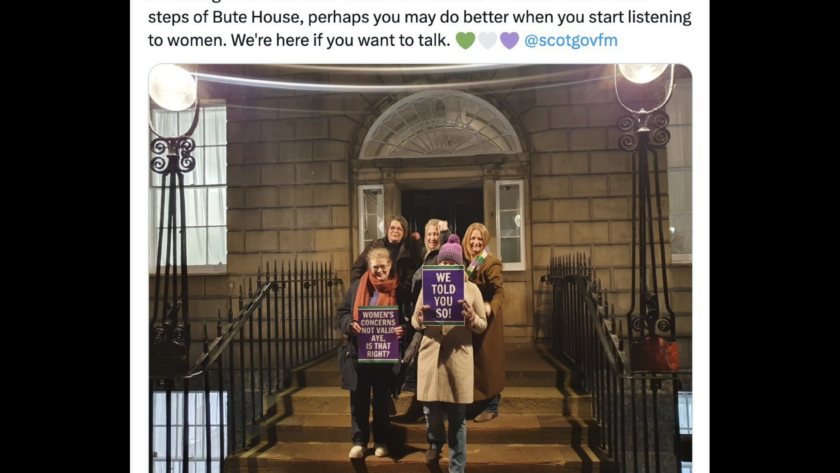
Note: the picture is of the members of Murray Blackburn Mackenzie, an independent policy analysis collective, made up of Dr Kath Murray, Dr Lucy Hunter Blackburn and Lisa Mackenzie. Their analysis is invaluable and can be found at https://murrayblackburnmackenzie.org. The other two women are Marion Calder from For Women Scotland (https://forwomen.scot/) and an unknown member of the Scottish Feminist Network.

Leave a comment

What did Parliament do?

It was not the Commission which changed the law allowing the Post Office to prosecute subpostmasters on the basis of flawed unreliable evidence. But MPs. Parliamentary scrutiny should mean something, shouldn’t it? Let’s see what it actually meant here. How did they discharge their function? Many are lawyers. One of the much touted benefits is meant to be that they can properly scrutinise such legislation and understand its implications. MPs also get expenses to pay for researchers. 

  • Did they ask any of the questions the Commission failed to? 
  • Did they check the Commission’s analysis or look at what the IT experts quoted in it actually said? 
  • Did they remember the many miscarriages of justice there had been in previous years and consider whether this change might become part of the ever expanding Law of Unintended Consequences? 

Having a memory going back more than a few weeks, curiosity, research, proper analysis: surely this is what MPs should be for? Will it come as much of a surprise to find that the answer to this is no? Not in this case anyway.

The relevant Hansard record provides the answer. MPs made the blindingly stupid mistake of thinking that because computer technology had become more complicated, thus making it more difficult to prove reliability, the answer was not to bother at all because this would be “impractical”. The idea that it was precisely this complexity which made it imperative to find a way of ensuring and proving that it could be relied on – especially in criminal cases when a person’s reputation, career and liberty might be at stake – did not occur to them. They did not question the Commission’s binary approach: keep S.69 as it was or remove it entirely. They did not consider replacing S.69 with something that better addressed the issue of establishing the reliability of computer evidence. Nor did they wonder how much more impractical (in all likelihood impossible) it would be for defendants to rebut the presumption by showing that the system was wrong, unreliable, not working as it should etc. Nor did they consider the costs associated with such a change, in particular, whether Legal Aid would pay for a defendant to challenge computer evidence.  

The relevant Minister – Paul Boateng (a solicitor) – treated it as a trivial change. He frivolously commented about eight year old children being the only ones to understand computers. There was simply no understanding of how complex computer systems operate nor any consideration of the consequences. Boateng seemed to think that the common law presumption worked fine with mechanical sources – traffic lights and speedometers – and so would work fine for evidence coming from complex corporate computer systems. It was unpardonably ignorant.

The result made it very much easier for the Post Office to do what it did. Its misconduct is not the only example of miscarriages of justice caused by this change. In 2015 a trial of nurses in S. Wales accused of wilful neglect of patients had to be abandoned because the computer log of patient records was deemed wholly unreliable. The judge criticised the hospital’s failure to have a dependable computer system in place. The details of the IT failings can be read here

Does this matter now?

Yes. The presumption that computer evidence is reliable unless proved otherwise is untenable. It is based on an ignorant misunderstanding of computer systems. It is not supported by IT experts. It has been a key factor in the worst miscarriage of justice in English legal history. The legal aid budget has been cut back even further since 2000 when the change was introduced. It is now practically impossible for a defendant to rebut the presumption.  This is not likely to improve any time soon. 

The fundamental problem is the poor understanding of IT by government, the legal system and many of its buyers. Its complexity and risks are not well understood and this has led to “lax legislation, lax regulation and lax procurement”. All have been seen in the Post Office scandal and all of them were caused by government. 

In 2022 the Justice Ministry said there were no plans to review the presumption “as it has wide application”. This is simply 2022’s version of the error made when S.69 was removed. Then it was “impractical” to expect people to prove that their evidence was reliable: too difficult. Now it is too much effort to review this because it’s used so widely. Again, too difficult. But it is precisely because it has wide application that it is imperative that it be based on a proper understanding. Ignoring the problems caused by a flawed decision 23 years ago will not make them go away. It simply means that their costs will be borne by those least able to pay. 

Fairness

This is – ultimately – a question of fairness. Fairness between the state and citizens. The state has immense power: to pass legislation, to prosecute, imprison and so on. There is little equality of arms between it and individuals. The very minimum they have a right to expect is that the state should use those powers fairly and responsibly, should correct mistakes promptly when they happen and should legislate responsibly, thoughtfully and on the basis of sound evidence. That did not happen here. 

In April 2021 the Court of Appeal said that the Post Office’s conduct in its prosecutions were “an affront to the conscience of the court.” It would be an affront to the conscience of Parliament for it to keep in place a flawed legislative change permitting such injustice simply because it does not want to confront the consequences of the poor decision it made so many years ago and now do the hard work necessary to put it right.

Photo by Massimiliano Morosinotto on Unsplash

Leave a comment

How was this sausage made?

What was the one development without which the Post Office scandal could not have happened? In a bitter irony, tinkering with a law enacted following a serious miscarriage of justice – the Confait case – the Inquiry report (yes, another one!) is here) enabled what is now the worst miscarriage of justice in English history. The law is the Police and Criminal Evidence Act 1984 (“PACE”); the tinkering is to S.69 – its removal and replacement by – well, nothing. 

Yes – it is time to look at how the Law Commission reached its recommendation. And, in the second part of this (here), the scrutiny MPs gave to the Commission’s recommendation.

This matters for three reasons:

  1. What the Law Commission did and how and Parliament’s role are outside the scope of the Williams Inquiry;
  2. There are decisions now to be made about how to correct this, decisions which Ministers are seeking to avoid; and
  3. This is not just a miscarriage of justice, a cover up, an IT failure, corporate failings by Post Office managers. It is a failure of governance by Parliament and  Ministers at every stage. It continues now.

Section 69 

This dealt with the admissibility of evidence obtained from a computer. To use it, a prosecutor (or defendant) had to prove the computer was operating properly (and if it wasn’t, this did not affect the accuracy of the document provided) and had not been used improperly. Important to note two points – because they lie at the heart of what the Law Commission got wrong:-

(1) admissibility relates only to whether something can be evidence (an exception to the hearsay rule);

but

 (2) it says nothing about the reliability, accuracy or completeness of that evidence.

The latter is a factual assessment of what a particular computer system is designed to do, how accurate it is for those purposes and whether that purpose and level of accuracy are sufficiently reliable in a criminal trial.

The Experts?

In 1997 the Law Commission recommended its removal. This meant that computer evidence put forward by the prosecution would be accepted as admissible and true unless the defendant could prove otherwise. This had a number of important and serious consequences:-

  1. It shifted the burden of proof onto the defendant in any case reliant on computer evidence;
  2. Defendants would need access to the necessary expertise and the money to pay for it if they were to rebut this presumption; and
  3. The prosecution would have to be scrupulous about disclosure relating to the workings of the computer systems from which it obtained evidence. 

Surely this last could be taken for granted? No: many of the miscarriages of justice in previous decades were because of police disclosure failings (e.g. the failure to reveal alibis in the Guildford Four case). Hence the creation of the CPS. But what of prosecutors not part of the CPS? 

The Commission’s analysis has been eviscerated in two articles here and here. In summary, it showed a woeful ignorance of how computer-based systems, particularly complex ones, work and the difference between hardware, software and data. It failed to understand the concept of technical reliability of complex computer systems (depending on their purpose), margins of error and the difference between this and the legal reliability of data produced. It consulted very narrowly; and it misrepresented what those computer experts it did consult said, so badly that it recommended the precise opposite of what they had advised. This is a very serious failing by a body whose expertise is the law not computer science. 

There is worse. One of the bodies lobbying hard for this change was the Post Office. It stated that this provision made it hard for it to prosecute its staff because of the difficulties of showing that its computer systems were working properly. The Commission appears not to have noticed that this was an entirely self-interested argument. Nor did it consider the Post Office’s obvious conflict of interest. Nor does it seem to have worried that, if a prosecuting authority no longer had to prove its systems were working properly, it had no incentive to ensure they were in fact doing so – at least to the standard required by the criminal courts. Nor did it ask itself whether it was right to shift the burden of proof to the defendant in something so important and complicated as computer evidence, given the then widespread use of computers and the likelihood of this increasing still further. Nor did it state how, if this shift were made, defendants would in practice be able to prove that the computer systems were not working properly, given the need for expert evidence and detailed technical disclosure. 

It did ask the question:

what sort of evidence must the defence adduce, and how realistic is it to suppose that the defence will be able to adduce it without any knowledge of the working of the machine?

(Note the confusion between hardware and software. And the description of a complex computer system as a “machine”.) 

It airily gave this de haut en bas answer:

a party cannot be required to produce more by way of evidence than one in his or her position could be expected to produce. It could therefore take very little for the presumption to be rebutted, if the party against whom the evidence was adduced could not be expected to produce more.

There is so much wrong here it is hard to know where to start. 

  • First, what is necessary as evidence is what is needed to satisfy a jury to the right standard. The prosecutor says the computer works fine. The defendant says: “The computer system is wrong but I can’t prove it” (much as subpostmasters did ad nauseam). What on earth is a jury going to make of that? The strength and validity of evidence is not determined by a defendant’s ability or resources. 
  • Second, the belief that only a “very little” would be needed is a pious hope. It is not set out in law as the low threshold which must be passed. 
  • Third, it completely ignores the practical problems of meeting even such a low threshold, especially in complex systems, unless full disclosure is made of all the problems and defects in such a system. It ignores the reality that, even if disclosure is made, expert evidence would be needed, a cost which most defendants cannot afford and which legal aid won’t often pay for.
  • It did not properly consider what sort of disclosure would be necessary by the party relying on computer evidence nor how to ensure that this should be produced in a way fair to all parties. 
  • Finally, the Commission seemed unaware of the concept of plea bargaining or defendants feeling forced into admitting guilt if they could not afford to mount a defence. 

It was bad enough for the Commission to get technical matters wrong as this undermined the recommendation it made. But not properly considering these fundamentally legal questions and presenting lofty answers untethered to the reality of the criminal courts was utterly inexcusable.

The Myth of Expertise

Why did the Commission take such a flawed approach? One answer which has been given is that it fell into the all too common trap of believing what it wanted to be true then finding the opinions justifying this.

Another is the myth of expertise. It is not uncommon for experts in one area to think that they can become experts in another without too much difficulty. It is a trap which lawyers all too easily fall into. Their ability to understand non-legal material, query it, explain it to juries, use it to make legal points can give the illusion of being an expert in it. But being able to question something, however expertly, is not the same as being an expert in it. Lawyers are not computer scientists. The Commission’s report was based on a superficial, faulty understanding of a very different discipline. 

In thinking that S.69 could be removed with no problems arising or unintended consequences, the Commission was, ironically enough, making the same mistake IT engineers sometimes make when fixing a bug in software – assuming (or hoping) that one change would not have other unwanted, unintended or unknown consequences. Complex computer systems are dynamic; so are legal systems. The criminal justice rules are like Jenga: if you pull one of the blocks out the whole thing can come tumbling down. The judgment is knowing what you can remove or change without undermining the tower.  

The issue should not have been what to do with S.69. Rather it should have been how to ensure the courts could properly assess evidence from computer systems, particularly complex ones, in a fair, effective, realistic way, taking into account the realities of such systems, disclosure obligations requirements and the need to have a fair trial. This was not done. 

It is unsurprising that one of the experts consulted – Alistair Kelman, an IT engineer turned barrister – wrote this in 2006 in his book “The Computer in Court”:

Today there are virtually no controls over putting computer evidence before the court….. The opportunities for fabricating computer evidence and …. destroying or altering audit trails are growing.

Although ….. I believe that nobody has yet been convicted in the UK of a crime they did not commit owing to inaccurate computer evidence ….. well publicised miscarriages of justice such as the Birmingham Six and the Guildford Four show how dangerous it can be to accept technical evidence in the courtroom at face value.

Prescient words. At the time he wrote this, many subpostmasters had already been wrongly convicted on the basis of inaccurate computer evidence, though this was not yet widely known.  The reference to the Irish miscarriage of justice cases is also key. The Law Commission might not have joined – or even be expected to join – the dots between what happened there and what would happen if S.69 were removed. But Parliament surely would have looked at the issue more widely.

Wouldn’t it?

View comment

What are Ministers for?

A key issue in the Post Office scandal is what its owner, the government, was doing – or not – while it happened. It is one (1) not within the inquiry’s scope, that being written by politicians and civil servants whose behaviour, or that of their predecessors, would otherwise come uncomfortably under scrutiny. Let’s look anyway.

The self-image of publicly owned entities is exemplified by the National Coal Board after nationalisation. Miners were photographed proudly holding signs saying collieries were now being managed ‘On Behalf Of The People‘. Alas, when the interests of the people clashed with those of the institution, when its wilful negligence killed the people’s children, guess whose interests came first? What is astonishing about the response to Aberfan was that, even when the Labour Prime Minister, Harold Wilson, said publicly the tip should be removed, the government/Coal Board refused to pay in full. The families had to contribute. It took 41 years before that money was fully repaid. This was only one of the many instances of a callous disregard for the interests of the people, both before and after the tragedy. A lovely sounding slogan turned out to be an empty promise at precisely the time when it should have meant something.

The events comprising the Post Office scandal started in the late 1990’s. Prosecutions/civil proceedings started in 1999 continuing until as late as 2016. Litigation by subpostmaster action groups and criminal appeals started in 2009. The Williams Inquiry announced in February 2020 became statutory in June 2021. During this entire time, the PO has been publicly owned, first as part of Royal Mail and, since 2012, as a separate company, wholly owned and financed by the government. It has a Board and Chair.

Its CEO’s:-

  • Adam Crozier, Royal Mail CEO 2003 – 2010
  • Moya Greene, Royal Mail CEO 2010 – 2018
  • David Mills, Post Office MD 2002 – 2005
  • Alan Cook, Post Office MD 2006–2010
  • Paula Vennells, Post Office CEO after its separation from Royal Mail 2012–2019 (2)
  • Nick Read 2019 to date

Its Chairmen (while it was part of Royal Mail):-

  • Allan Leighton 2002 – 2009
  • Donald Bryson 2009 – 2011

Thereafter:-

  • Alice Perkins 2011 – 2015
  • Tim Parker 2015 – 2022
  • Henry Staunton 2022 to date 

These are just the CEO’s and Chairs. It had many other directors during this period, about 80 directors in total over the entire period. The Post Office publishes accounts. It has external auditors (E&Y until 2018, PwC thereafter). The government has claimed that it operated “as an independent, commercial business within the strategic parameters set by government.” On this point – particularly the reality of how independent it actually was from government – recollections may vary.

Nonetheless, despite having all the structures of a company – including large salaries and bonuses for its directors – it did not have any of the constraints or scrutiny which public companies face: no analysts questioning its management, reviewing its accounts, no shareholders able to express views at public meetings or privately or show their displeasure by selling shares. No regulator either. It had all the advantages with none of the downsides. Worse: it had privileges other companies do not – its own internal investigators able to investigate and prosecute with few of the legal requirements or training expected of the Crown Prosecution Service (“CPS“) or police. 

What of politicians? How did they exercise oversight? Did they exercise any? Since 1998 the Business Ministers were:-

  • Peter Mandelson
  • Patricia Hewitt
  • Alan Johnson (ex-postman)
  • Peter Mandelson (again)

followed by 9 Business Ministers since 2010:-

  • Vince Cable
  • Sajid Javid
  • Greg Clark
  • Andrea Leadsom
  • Alok Sharma
  • Kwasi Kwarteng
  • Nadine Dorries
  • Michelle Donelan
  • Kemi Badenoch. 

Also since 2010 there have been Ministers with specific responsibility for postal affairs:-

  • Ed Davey
  • Norman Lamb
  • Jo Swinson
  • Jenny Willott
  • Jo Swinson (again)
  • Margot James (the only Minister so far to express any regret about their role in this affair)
  • Andrew Griffiths
  • Kelly Tolhurst
  • Paul Scully
  • Kevin Hollinrake. 

A veritable carousel of people scarcely known in their own households let alone the wider public, in office for too short a time to get to grips with their responsibilities.

But they had civil servants and a director on the Post Office Board, there specifically to represent the government. Over the relevant period that person was:-

  • Susannah Storey 2012 – 2014
  • Richard Callard 2014 – 2018
  • Tom Cooper 2018 – 2023 (3)
  • Lorna Gratton May 2023 to date

All of these are civil servants, save for Tom Cooper, an investment banker for many years. Richard Callard trained and worked as an accountant before joining the civil service in 2009.

So what, as reportedly asked by a child seeing Gladstone make an interminable speech, are all these people for? 

What questions were Ministers and civil servants asking? What, in particular, was the director representing the shareholder’s interests doing and asking? Did any of them think to question, for instance:-

(1) The wisdom of allowing the Post Office to investigate and prosecute its own cases? 

Or (2) how the new and key accounting IT system was being commissioned, what independent testing and auditing there was? 

Or (3) what the auditors, both internal and external, were doing. (4)

These are not hindsight questions. The CPS was created in 1986 in part to avoid an obvious conflict of interest in having the same body (the police) investigate and prosecute cases. Did no-one ask why the Post Office should have powers denied to the police? Did no-one wonder whether the Post Office’s structure created an obvious conflict of interest which could be open to abuse? Did no-one ask how that conflict was going to be managed or mitigated? 

When prosecutions started happening did no-one (the law officers even) wonder what was going on? Did no-one ask whether an accounting system which might have been sufficiently reliable as a source for corporate accounts might not be suitable as a reliable source of evidence for a criminal trial? The government claimed in 2020 that it did “not play a day-to-day role in the litigation or on the contractual and operational matters that were at the heart of it”. This is a claim contradicted by the evidence given to the Business Select Committee about the close working relationship between the Post Office’s Board, the government-appointed director and the Business Department. It also begs the question of why it was not so involved. It had to finance the litigation and the various compensation schemes that the Post Office sought to set up. Someone must surely have briefed it on the 2018 common issues judgment and what Mr Justice Fraser said about the Post Office’s behaviour. It is simply not credible that the government financed the Post Office during this period without being involved in some capacity in the matters which led to the litigation. Not least because the Post Office directors needed to satisfy themselves that the Post Office was a going concern. How could they do so without some assurances from Ministers? How could Ministers give such assurances without understanding the extent of the litigation and the potential compensation liabilities if the Post Office was wrong in what it was asserting? And if the government did pay without asking even the most basic questions, it is – surely – an admission of a grossly negligent and worryingly casual approach to public money.

Nor have government IT failings been unprecedented. Rather, they are the norm, as endless reports from MPs and the National Audit Office have said. Yet, despite all this, despite Harriet Harman raising concerns with Blair about Horizon failings in 1998, despite him saying in Parliament in April 2000 “When we came to office, there was probably no greater shambles than the Horizon project”, despite endless Computer Weekly reports describing multiple problems, all these Ministers and civil servants missed or turned a blind eye to what was happening, accepting the assurances given by the people with every interest in replying: “Nothing to see here, guv”. Can so many senior/apparently intelligent people be so lacking in basic scepticism or curiosity? At best they interpreted an arm’s length relationship with a company as a reason to ask no probing questions at all. At worst, it was – and is – culpable negligence. They may as well have been replaced by a cardboard cut-out of Mr Pangloss.

Notably one MP – James Arbuthnot – did spot the two key issues at the heart of this:-

(1) the unreliability of computer systems; and 

(2) the tendency of institutions to deny problems and blame individuals to save their reputations. 

He did so because of his previous experience with the 1994 Mull of Kintyre Chinook helicopter crash. He did what ought to be done as a matter of course but too often isn’t. He read across from his knowledge of that matter, realising that the same system failures and human misbehaviours can and do happen in different sectors. It is one vital step which ought to be done at the end of every investigation. There is, however, no institutional capacity, structure or willingness to do this within one institution (see the repeated reports about the police or NHS) let alone across sectors. 

This is not just a historical matter. There will likely be more state owned bodies under a Labour government: it has already promised a “GB Energy” company, for a start. The Post Office is only one of many state owned bodies failing in ways causing great suffering to the people in whose interests they are meant to exist. This is not an argument for privatisation (private monopolies with weak regulators are hardly an example to emulate). The issue is not ownership. It is how government entities are governed, controlled and kept up to high professional standards. It is how governments avoid creating conflicts of interest or manage them properly, if unavoidable.  It is how their Boards and managers are made meaningfully accountable. 

What we have instead is an unholy trinity of poor commissioning, false economies and weak supervision and oversight. Only when the matter goes “Splat” do we then roll out the best lawyers money can buy, embark on gold-plated, fantastically detailed and interminably long inquiries and produce splendid reports few read and even fewer act on. This is, bluntly, arse about face. We have a state congratulating itself on its magnificent reports while ignoring any meaningful steps to get things right from the start or resolve problems early. The government announced this week it won’t even take steps to accelerate the appeals process, despite its own Compensation Advisory Board stating “the justice system itself is called into question in the current circumstances.” It will do nothing. There are no signs that Labour even understands the problem let alone know what to do about it. But backroom as good governance and accountability issue may seem, they are nonetheless one of the next government’s vital tasks. 

Notes

(1) The other is the legal system: the Law Commission, appeal courts, civil and criminal courts, certain senior judges, in-house and external lawyers, internal investigators and prosecuting counsel. A whole topic worth exploring separately.

(2) Yes, you read that right: the post of Post Office MD was abolished while the separation from the Royal Mail and the latter’s privatisation were being implemented. It was also during this period that questions and concerns were increasingly being asked by subpostmasters, MPs and others about Horizon and the prosecutions. And, yes, who exactly was in charge is a good question to ask. One day we may even get an answer.

(3) Tom Cooper resigned as a director in May not long after the issue of why the Board had given itself bonuses for complying with the Williams Inquiry while being untruthful about this in its published accounts. Mr Cooper was criticised by the Business Select Committee for not making it aware of this matter for a number of weeks after he first became aware. The Post Office stated that his resignation had been planned since February.

(4) The issue of what the auditors, both internal and external, were or were not doing is explored here.


View comments

Going Postal

There comes a point in many investigations when you know exactly what has happened, why and who is at fault. It may not mean its end. But the essential findings are clear, no matter what’s needed to colour in the whole picture.

What happened on Tuesday at the Post Office Inquiry was such a moment. There were two events. The first was the evidence of Elaine Cottam, eviscerated here by Nick Wallis as an “obtuse, thick-as-mince, malevolent incompetent”. She displayed the attributes we have come to expect from Post Office witnesses, both internal and external: incompetence, no understanding of her job or the systems she was supposed to be administering, a lack of professionalism, convenient memory failings, a total disregard for truth, obligations to the court – whether over witness statements in civil or criminal proceedings or in this inquiry – utterly disregarded and malice, as shown by her sly attempts to slander a Subpostmaster’s husband on no evidence whatsoever. Wallis’s description could apply to pretty much all Post Office witnesses (with rare exceptions, one of whom gave evidence on Wednesday). This has been the case ever since the March 2019 Bates litigation when Mr Justice Fraser found a number of different creative ways of saying the Post Office’s witnesses were liars, without directly using that term.

The second was the revelation that the Post Office had discovered ca. 363,000 potentially relevant emails dating back to 2012 it should have – but hadn’t – disclosed. Yet another postponement would be needed. This is not the first time this has happened. There have been seven previous occasions when the Post Office has admitted failing to disclose relevant material. Seven. In the two years since it became a statutory inquiry in June 2021. As Inquiry Counsel, Jason Beer KC said, the Post Office’s conduct is obstructing the inquiry.

This is not an inquiry-specific problem. The Post Office’s failure to disclose – right from the start – the problems with Horizon resulted in malicious prosecutions and civil proceedings against subpostmasters and the misleading of various criminal and civil courts which sought to get to grips with the extent and nature of this scandal. Now it is doing the same to the Inquiry. This is no longer – if it ever was – a result of incompetence or the inevitable difficulties of extensive disclosure. This is an organisation which is simply refusing to take the Inquiry seriously, as it has refused to take seriously any of the legal processes it has abused for its own ends. 

The Post Office is not fit for purpose. It is an organisation unwilling to comply and/or incapable of complying with the requirements placed on it, whether those of the Inquiry, those relating to its accounts or those imposed by Parliamentary Select Committees. It is out of control – and has been for some while.

On Thursday we learnt from Kevin Hollinrake, Under Secretary of State in the Business Department that the Post Office has discovered operational issues” which financially prejudiced subpostmasters and for which another compensation scheme is to be set up. Yet another WTAF moment. 

These repeated failings are not just evidence of the failure to comply with the Inquiry’s requirements. They are proof that everything alleged about Horizon and how the Post Office dealt with it are true. They show in the clearest possible way that the Post Office has no clue what is going on inside the organisation and that its word on anything simply cannot be trusted. Res ipsa loquitur, as lawyers liked to say – the thing speaks for itself.

What Now?

The Inquiry Judge could issue S.21 Notices holding the Post Office in contempt of court; he can make rulings; he can even write all sorts of damning assessments in his final report. But really: why grind on with this for the next few years? The Post Office is making a farce of the inquiry. It is abusing it because its endless obstruction reduces even further the chances of the subpostmasters (and their families) finding out the truth before they die, of receiving proper compensation before they die, of ensuring that those who have committed crimes face justice and so on. It is an affront to the conscience of the inquiry to allow this to continue.

The Judge is behaving as if all parties are seeking the truth. The Post Office (and its advisors) are not even on this pitch. It is playing a quite different game – seeking to delay, obfuscate and deny, to do everything possible to ensure that the truth will never be known or so late that nothing can be done to those responsible and that it becomes merely a matter of historical interest – at best. 

The Judge should – but likely won’t – say that there is little point to the Inquiry: there has been enough evidence to show that the Post Office has utterly failed at all stages to implement an effective IT system, has lied about what it knew, has abused the criminal and civil justice system, and is now abusing the inquiry process. He should say that it is only the government – as its owner – which can take steps to make proper, full compensation now. It is only the government – as its owner – which can take steps to replace the entire Board, pretty much most of its senior management and many of the staff and rebuild the entire organisation from the bottom up. It is only the government which can take legislative steps to quash the convictions of everyone prosecuted by the Post Office over the last two decades. It is only the government which can take action against the Post Office’s directors, past and present. It is only the government which can take steps to ensure that Fujitsu is banned from any government work. It is only the government which can make clear to the Post Office what it must do to comply with the inquiry properly. 

He should say that given how long the inquiry has been going on and the number of Post Office failures to comply, he must now assume that the government has not made this clear. He can therefore have no confidence in the competence or good faith of Post Office staff charged with complying with the inquiry and is no longer prepared to allow the inquiry – or the subpostmasters – to be made fools of in this way.

He should, in short, tell the politicians that when they own a company it is them – as owners – who are responsible for its actions. It is now time for them to take responsibility for their creature – not dump it onto an inquiry and processes (such as prosecutions for perverting the course of justice) which will take an age, if ever, to come to a resolution.

Ultimately, this scandal arises from a failure of governance – by the Post Office’s directors, certainly –  but also by the politicians to whom they were and are answerable. When a publicly-owned body fails, the responsibility rests with the elected government. As does the responsibility for fixing the problems.

How and why this governance failure happened and its implications for other state owned entities will be discussed separately. 

Photo by Mick Haupt on Unsplash

Leave a comment

Making An Offer They Cannot Refuse?

On Monday the government finally came up with a “take it or leave it” compensation offer to the subpostmasters. £600,000. It was described by Kevin Hollinrake, Minister for Postal Affairs, as “providing a generous uplift” on compensation payments already made. Let’s see how generous it really is.

  • Some subpostmasters were convicted as long as 23 years ago, between 2000 – 2015, the majority in the earlier years. That is compensation of between £26,000 and £75,000 pa. The sums on offer are less than what they would have earned had they not been wrongly convicted.
  • It is an uplift only by reference to compensation payments described as inadequate and criticised by the Inquiry judge.
  • It takes no account of the losses suffered by those made bankrupt and those who lost homes and businesses.
  • Nor does it compensate for time spent in prison / injury to reputation and legal costs incurred in fighting criminal cases and appeals.
  • Will it be tax-free? One subpostmaster who managed to get compensation then found that much of it was taken away in taxation and payment of bankruptcy leaving him with so little he was unable to heat his home last winter. The structuring and tax treatment of compensation payments and how this has been misdescribed to subpostmasters has been one of the (many) criticisms made of one the Post Office’s many legal firms.
  • It is also unclear whether this is a floor – leaving some able to pursue the Post Office through the courts for more to reflect their actual losses. If this were the case, it might have some merit. If not, it is effectively presenting subpostmasters with Hobson’s choice: inadequate compensation or the prospect of spending more time and money trying to fight an organisation determined to do the minimum possible and unable (or unwilling) to comply with its legal requirements.
  • Above all, it is limited to those who manage to overturn their convictions in the courts. Note that the Post Office is still opposing many of these appeals, even where the evidence came from the Horizon system. This also excludes those who pleaded guilty because they felt unable to challenge the Horizon evidence and were unaware of the Post Office’s disclosure failings. Despite all the evidence about Horizon’s failings and unfitness for purpose, despite knowing – as the Minister put it – that Horizon data was “unreliable” (a gong please for the civil servant coming up with that description for data more accurately described as “untrue“), despite all the failings in its disclosure to defendants, the Post Office is still trying to argue its case.
  • Finally, compare it with the bonus of £485,000 the Post Office CEO recently received for one year, a part of which was for complying with the inquiry, a compliance which did not occur, infuriated the judge, was lied about in its accounts and signed off by the Board. This Board then commissioned a report which managed to say that everything was tickety-boo but, no, they could not identify any actual human being who had signed off or written the untrue statements in the accounts or explain how it was that the accounts misled this issue. Then it promised not to pay bonuses at all before admitting under cross-examination that this too was another lie – as all executives were in fact eligible for bonuses for complying with an inquiry necessitated by their previous wrongdoing.

The Minister insisted in Monday’s debate that the government wanted to ensure “swift and fair” compensation. Whatever this process can be described as, “swift and fair” is not it. The government presents itself as above the fray, generously funding the Post Office. In reality, the government has been responsible in a number of ways:

  • Its supervision of the Post Office and its management;
  • Its relationship with Horizon (the correspondence between Harriet Harman and Tony Blair about Horizon’s inadequacy at a very early stage is worth reading to see how early matters started to go wrong and how);
  • The failures of the criminal justice system; and
  • Its control over how the Post Office has responded to the miscarriages of justice and the government’s own inquiry.

The compensation offer came as a surprise on Monday. Why? Well, on Tuesday we had one of the Post Office auditors, Helen Rose, giving evidence. She audited one of the subpostmasters who reported problems with Horizon and sought help. This lady had no qualifications or training as an auditor; no training or experience as an investigator and no training on the Horizon system (that she could remember). She gave written evidence to the High Court supporting the case against the subpostmaster (despite her original report showing flaws in Horizon). From her evidence now it is clear that she left out key information, removed anything true which might have helped the defendant, put in incorrect information and inserted defamatory and untrue statements about the person being investigated. She signed it as true but accepted that it wasn’t. She could not, however, remember how this came about. She could not even remember whether she had been subject to a disciplinary process as a result of the suicide of a subpostmaster she had met and audited. This convenient memory loss is likely to be repeated during this phase as various professionals – from auditors to IT experts and lots and lots of lawyers – give evidence, as the evidence of today’s witness shows.

When hearing evidence like this from people plainly not up to their job, utterly careless of their obligations and seemingly lacking any sense of professionalism, I think of the words of one bereaved Aberfan mother listening to the evidence of NCB officials: –

What I heard there was very difficult for me to accept. Because most people who were brought to the stand seemed to think it was somebody else’s fault. Not theirs at all. I believe one of the engineers got on the stand and he didn’t seem to realise his dreadful part in this happening. And when I heard what he had to say it made me feel sick because it looked to me as though he couldn’t have cared less about what had happened on account of his neglect. It was a good thing that I wasn’t on the stand or wasn’t talking to him, you know, because I’d have floored him.

If we are ever to have a hope of preventing this or any injustice reoccurring, if we are ever to provide some justice to those so grievously harmed, those responsible need to be made accountable, to suffer consequences – and soon. If not, “flooring” them may be the only option. It feels like a vain plea. But I make it nonetheless.

View comments

Did You Really Mean To Say This?

In our time, political speech and writing are largely the defence of the indefensible.

So wrote Orwell in 1946.

Today has given us 2 examples of how language is used to obscure the indefensible. But not from the political world. For a change.

Example No 1

The  announcement by BP that its CEO, Bernard Looney, left because, when providing answers in an earlier investigation about his relationships with colleagues, “he now accepts that he was not fully transparent in his previous disclosures. He did not provide details of all relationships and accepts he was obligated to make more complete disclosure.

Not fully transparent”. In old money: “He lied”
“Obligated to make more complete disclosure.” = “He should have told us the whole story”

These carefully crafted phrases are now the latest in a sequence of phrases which all mean the same – in substance – but which increasingly try to avoid actually saying it.

  • It started with “lie”.
  • It then proceeded to “economical with the truth” (used in 1986 by the then Cabinet Secretary to Mrs Thatcher, Sir Robert Armstrong, in the British government’s doomed attempt to stop Spycatcher – Peter Wright’s colourable account of MI5’s activities – being published). This was greeted with well-deserved derision but at least had the merit of using the word “truth”.
  • Economical with the actualité” was then used by Alan Clark in the Matrix Churchill arms to Iraq trial in 1992. Quite why a Tory politician famous for telling his civil servants in Defence – presumably as a joke – that British missiles should be aimed at the real enemy, France (or so he records in his diaries) should dress up this phrase in French is not made clear. Unlike Mr Looney, though, Alan Clark was all too transparent, indecently so, about all his liaisons.
  • Clarification”: a simple word meaning, in reality, an admission that what was said before was completely untrue. Or that what is being said now is exactly the same as what you said before even though it is the complete opposite. Often used to “clarify” a “full and frank disclosure” which has turned out to be anything but.
  • Now we have not being “fully transparent”.

Example No 2

This letter from a recently retired consultant anaesthetist, Dr Peter Hilton was published in today’s Times, in response to this article yesterday about sexual harassment and rape within the surgical profession.

Sir, This “snowflake generation” of young doctors, largely female and selected on mainly academic excellence, clearly did not do their homework. Medical training and practice is brutal and demanding, with long hours, and bullying happens. Sexually inappropriate comments and actions do occur. It is stressful. All I can say is that if they want to make a success of this rewarding career then they should toughen up. Perhaps four A*s at A-level are not the answer to all the problems they will face.

There are – quite apart from the implication that stress explains sexual assault and bullying – a number of problems with the language used in this letter.

  • The female doctors “did not do their homework”. Quite what they were supposed to do is not explained. Imagine that last question from the interview panel: “Is there anything you’d like to ask us?” “Well, yes, there is, actually. How stressful is this job? I’d like to know how much sexual assault and sexually inappropriate comments I should expect?
  • The use of the word “inappropriate”. It is a word best used for minor social solecisms or impoliteness. Using it to describe behaviour amounting to crimes is a way of obscuring the truth, of diminishing the seriousness of what is happening, above all, of showing contempt for those to whom it is done.
  • The convenient use of the passive voice. “Bullying happens”. “Sexually inappropriate comments and actions do occur”. It just “happens” does it? A sort of ethereal bullying with no actors responsible for it, then. Bullying – like those “sexually inappropriate actions” – does not just occur or happen. It is done by people – often men or people in a position of power – to other people – often women or people lower down the hierarchy or younger or not in a position to resist. It is a choice by those doing it. It is – does this really need saying in 2023? – wrong.
  • Finally, the exhortation that “they should toughen up”. Ah yes, sexual assault as a character-building experience.

When language like this is chosen, it is designed to obscure some – usually pretty unpleasant – reality. But it is unintentionally revealing of the author.

What conclusions to draw?

Mr Looney will now be reflecting that, as so frequently happens, it is the cover up – not the misbehaviour – that gets you. He will realise that when asked questions in an investigation, it pays to be truthful in your replies.

The public are left no clearer as to what actually went wrong at BP. But that’s OK because BP has moved on, its announcement having been carefully finessed by lawyers and communications professionals.

The doctor’s letter will likely not have been, despite him being a published author (“It’s Been a Gas? The life of an Anaesthetist” – available online, 1-star rating, which seems all too appropriate for something written by an expert in rendering you unconscious).

Some free advice.

  • There are letters/emails you write, usually when irritated, angry, upset or just tired, especially late at night or when you’ve been very busy, which may perfectly express how you feel. Then.
  • But once written, you read (or get someone else to read) them and, having got all this off your chest, you go to bed. The following day you press the delete button.
  • If you absolutely have to send them, check with someone else how the letter comes across. You may – to be as charitable as possible – have not expressed yourself well.
  • If you send in haste, in fury, without a sense check, you will make a fool of yourself – or worse.

This was one of those letters.

Photo by Scott Graham on Unsplash

Leave a comment

A Fright at the Museum

What on earth has been going on at the British Museum?

  • For two decades it appears that Greek and other classical antiquities from the 15th century BC to the 19th century AD in store have gone missing, stolen or damaged. It is now estimated that around 2,000 items have gone missing. Their value is inestimable.
  • Some reappear on eBay and elsewhere “for sale“.
  • February 2021: An antiquities dealer, Ittai Gradel, notifies the museum that 3 items belonging to it – specifically pieces of Roman jewellery – are being sold on the open market. He also tells them about other items he has acquired.
  • He is subsequently told that there is nothing to worry about because the “collection is protected“. 
  • Specifically, the Deputy Director, tells him there had been a “thorough investigation“, “there was no suggestion of any wrongdoing” and security procedures are “robust“.
  • Another buyer, prompted by Mr Grabel, returns an item to the museum. So does Mr Grabel. He also gives them buyers’ names.
  • According to reports, an unnamed member of staff was investigated over allegations of “impropriety” in 2021 with the police involved but the case went no further.
  • By autumn 2022 the dealer has contacted one of the trustees. He is concerned that the museum is “sweeping matters under the carpet“. The trustee is similarly concerned and the museum’s director, Hartwig Fischer, is asked for information about the investigation, its timeline and conclusions. The director responds with an assurance that “there is no evidence of wrongdoing” and that the three items are “in the collection“. 
  • At some point in 2022 a new audit is carried out.
  • January 2023: the Metropolitan Police’s Economic Crime Unit is called in to investigate.
  • July 2023: Peter Higgs, 56, the museum’s curator of Greek collections, Greek sculpture and the Hellenistic period is dismissed after the management learn that treasures have been reported “missing, stolen or damaged“. In 2002 he had told a reporter looking at how treasures were stored in the vaults: “It’s chaos down here.
  • August 2023: The Director expresses frustration that the dealer had not said more in 2021 and implies that this impeded the museum’s investigation. The dealer says this is a lie.
  • The Director resigns, apologises for his accusation against the dealer and withdraws it. 
  • He also says that it was “evident” that the museum did not respond “comprehensively” to warnings of thefts in 2021. 
  • The Deputy-Director also resigns. Or is “asked to step back from his duties“.
  • The usual statement of regret and praise for their departed directors’ abilities is issued by the trustees. 
  • A circular firing squad starts being formed at the museum. It is reported that the trustees are asking why it took 8 months for them to be informed of the allegations. The Chair of Trustees, George Osborne says that the previous statement that there had been a “thorough investigation” and “no thefts” was “obviously completely wrong.” Doubtless intending to be helpful, he also says that “groupthink” among the museum’s bosses may have been responsible for them not believing that an insider could be stealing. A reminder that Peter Higgs has denied wrongdoing and no-one has been charged. A reminder also that improprieties in the art and antiquities world have been well-known for years and might be expected to be known to museum bosses.
  • The trustees also announce an independent review of events and security to be headed by a former museum trustee, Nigel Boardman, an ex-City lawyer, last heard of when appointed by Boris Johnson to head up the inquiry into the Greensill affair, and Lucy D’Orsi, Chief Constable of the British Transport Police. The actual or potential conflict of interest arising from having a former museum trustee review the activities of the museum and, inevitably, its governance over many years and how this might – or appear to – affect the review’s independence does not appear to have occurred to anyone. Nor it is immediately obvious what particular skills the British Transport Police bring to such a review. 
  • The Chair of Trustees says that the process for finding a new director will start. 

George, sweetie: I have news for you. You need to find – at a minimum:

(1) a new director; 

(2) a new deputy; 

(3) a new curator of Greek antiquities; 

(4) a new head of security;

(5) someone who knows how to carry out “thorough” investigations; 

(6) someone to liaise with the police – a full-time job; 

(7) some bloody good legal advice given the various statutory obligations the Museum, its management and trustees are under;

(8) someone to run and catalogue the Museum’s vaults and store rooms. A notebook, pen and camera would be a start. Perhaps even some clearly labelled boxes.

(9) someone to say with a straight face, repeatedly, that the Elgin Marbles are safe with the Museum. Actually, you could do this: you’ve got the brass neck and have had plenty of practice saying the scarcely believable (remember “we’re all in this together”?)

And that’s for starters. A full-time Chair would not go amiss at this point either.

There are plenty of questions to be asked and, doubtless, more to be revealed. Still, for now, could I make this plea? Will the last public organisation in the UK run even remotely sensibly, competently and lawfully, please wave and say hello.

Just so that we can be reminded of what this looks like.

We might even put it in a case for display in …. oh!


Photo by deepigoyal on Unsplash

Leave a comment

A Good Deed

The government has finally done something right! I know. Scarcely believable. Admittedly, it’s early days and it’s by its Legal Department (which usually manages to maintain some modicum of integrity and competence – or tries to anyway.) Small mercies. What has it done? The Secretary of State for Justice and Lord Chancellor, Alex Chalk, and Attorney-General, Victoria Prentis have announced an independent inquiry into the Andy Malkinson case. This will be into all the relevant authorities: the Greater Manchester Police (1 of 5 police forces in special measures), the Crown Prosecution Service and the Criminal Cases Review Commission. All three of them have pledged their full co-operation, not that they had any alternative, despite their own separate inquiries. The IOPC is looking at the police’s behaviour but, given its feeble record, little could have been expected of it. The CCRC has appointed a KC to review its behaviour; doubtless his findings will be fed into this one. The Law Commission is also reviewing this case as part of its wider review into the criminal appeals process.

It is not just what has been done but the way it has been done which is worth praising. The announcement states: “The inquiry will ensure Mr Malkinson’s views and experiences are heard throughout the process and this will be reflected in the Terms of Reference.” This is an improvement on the CCRC’s announcement a few days ago which did not even bother to inform, let alone consult, Mr Malkinson or his lawyers.

While the CCRC is being looked at, the role of its Chair, Helen Pitcher, should be reviewed. Like many of the Establishment’s Poo-Bahs, she has quite the CV, specialising in Advanced Boardroom Excellence. She is also Chair of the Judicial Appointments Commission (on top of various other directorships). Quite why she (despite her law degree) nor anyone appointing her to this role in February this year has not noticed that this creates a conflict of interest, certainly a perception of one, has not been explained. Let me spell it out: those appointing judges should not also be the ones determining whether those judges may have presided over a miscarriage of justice. The CCRC’s role is anyway important enough to warrant someone better than a part-timer treating the role as part of a portfolio.

From being largely ignored, Malkinson is now the centre of attention. As he should be. It is all too common for services such as these to forget the human beings at the centre of them. An injustice has been done to Mr Malkinson – deprived of two decades of normal life, to the raped woman who will now have to endure a second trial and to any victims of her attacker during the time he has been left free. We have to hope that, unlike the many other inquiries currently happening and announced, this one will not take years and will lead to some practical changes for the better. Not merely recommendations to be ignored until the next cock-up. Inquiries should be a means to identify action to be taken. Not as a substitute for it, a way of doing nothing at all.

If governments want to know what this looks like, they need only look at what patient, polite but persistent questioning and inquiry by the Business Select Committee’s Chair can achieve. Darren Jones has managed to get the Post Office’s CEO to return all the bonus given him under the false pretence that it has co-operated with the Williams Inquiry. It is more than the Business Secretary, Kemi Badenoch, and Minister for Postal Affairs, Kevin Hollinrake, have managed in the 7 months they’ve been in post. There is, of course, the rest of the Board to persuade to do the same. But it is a start and a credit to an MP and a Select Committee which understand what their role is.

One of the KC’s acting for some of the subpostmasters is Edward Henry KC. He acted for Andy Malkinson, as did Max Hardy and APPEAL, a charity focused on miscarriages of justice. In a week which has shown us the worst people can do, it is some consolation to find some MPs and professionals showing us the opposite.


Photo by N R on Unsplash

Leave a comment

The only lesson

7 murdered babies. Attempts to murder 7 more.

A hospital’s reputation in ruins.

(Oh – and another inquiry to report on all the lessons to be learnt. Like the ones not learnt from previous inquiries. Just as these ones won’t be.)

It is not too cynical to say that care for the hospital’s reputation – rather than investigating serious concerns about staff responsible for babies in their care – was almost certainly one of the main reasons why senior NHS managers, many of them trained doctors and nurses, sought over a year to dismiss and disregard repeated concerns and red flags raised by doctors about Lucy Letby, the nurse found guilty of those murders.

They didn’t just ignore them. According to this Panorama report, they warned off the doctors, threatening them with “consequences“, including possible referral to the GMC. A line had apparently been crossed by daring to criticise a nurse described as “nice Lucy“. After two triplets died, duty executive Karen Rees, who refused to take Letby off duty against the wishes of 7 consultant paediatricians, was asked if she would take responsibility for anything that might happen to other babies and replied “yes“. We will learn now, won’t we, what value to place on that “yes“.

Why do senior executives do this? To protect the institution’s reputation is the usual reason. It never works. When you fail to look into concerns when first raised – and it really doesn’t matter which sector you’re in – the NHS, the police, banks, the press, Parliament, the army, the Guides, churches, the Post Office, oh just about anywhere, let’s face it – these are the consequences:

  • A small problem turns into a bloody big crisis.
  • You trash your reputation
  • You lose trust.
  • You’ll be clearing up the mess for years.
  • It will take longer than you can possibly imagine to rebuild that trust. Do not fool yourself into believing that quickly shuffling some people around (even out), some shiny new procedures and training, no matter how brilliant, will do it.

It is not the first time the NHS has got itself into these sorts of difficulties. Its treatment of whistleblowers has long been appalling. Similar events happened – and for many of the same reasons – at the Gosport War Memoral Hospital (see my commentary here on the report issued in June 2018). And that is only one of many. NHS management seems utterly oblivious to The Public Interest Disclosure Act 1998. The NHS – like the police – is one of those sacred cows that confuses the importance of its function with the importance of the institution and the egos of those running it, focused on their Key Performance Indicators (none of which would have included “murders solved“). This is a fatal flaw, inimical to the establishment of a healthy work culture. Politicians – those available in the foreseeable future anyway – are unwilling or unable to challenge or change this.

There is another reason why senior staff behave like this.

Cowardice.

Taking a concern seriously means exercising judgment and taking action. The judgments to be made will be difficult. There is no procedure which can act as a substitute for good judgment. The actions will often be tough. So it is easier – much easier – to do nothing (or the minimum you think you can get away with) and tell those bringing unwelcome news to keep quiet.

Senior staff would do well to remember these words:

All organizations have bad apples but what an organization ….. also has is well paid and exquisitely educated bosses, part of whose job is to spot these bad apples and, if they are spotted, deal with them.”

Who said this? Andy Webb, the BBC journalist, who uncovered the story of how Martin Bashir and Panorama (oh, the irony!) got that interview with Diana, in May 2021. He said about the bosses who failed to do anything about the ethical breach they knew had happened: “It’s my feeling the bosses were not brave enough …. and it prompted the cover up.”

Not brave enough. That’s the only lesson to learn right there.


Photo by The New York Public Library on Unsplash

Leave a comment