Skip to content Skip to sidebar Skip to footer

The Cheque is in the Post

Remember the De Lorean fiasco? To provide jobs in Northern Ireland, the then government paid the bouffant-haired car designer to set up his factory there. It collapsed a few years later amidst missing money and fraud. Arthur Andersen, the auditors, who admitted missing obvious fraud signs, were banned from government work and sued. It was only when Blair won that the ban on AA was lifted and a risible settlement agreed. (Doubtless entirely coincidentally, AA had provided free advice to Labour in opposition. A “scratch my back and I’ll scratch yours” approach to favours has never restricted itself to one party.)

Fast forward a quarter of a century. Fujitsu, whose Horizon accounting system used by the Post Office, was responsible for the largest miscarriage of justice in British history, has suffered no similar penalty. Indeed, no penalty at all. Far from it. It has been rewarded with more lucrative government contracts; it has not paid any compensation; no company official has been held responsible.

Why? Well, one answer is that AA’s failures harmed the government. Whereas Fujitsu and the Post Office only harmed some lowly sub-postmasters and mistresses. A cynical take. But an accurate one. The brutal reality is that being in public ownership or a public service does not automatically mean an organization behaves well. Worse, it often means that when it causes harm to others, its primary interest is to protect itself – even at the expense of those it has harmed. This is not new. See how the Aberfan families were treated in the decades after the loss of their children. Or the victims of the blood contamination scandal or many other NHS scandals or Windrush.

This story shows a state – and many of its key functions: the Post Office, owned by the state, the criminal justice system, run by the state, and the responsible Ministers and civil servants – to be malign, incompetent, indifferent to the damage caused, defensive and determined (behind all the paraphernalia of inquiries, reviews, assessments) to delay the allocation of responsibility, effective consequences for those responsible and proper, timely compensation for those harmed. It is no consolation – nor anything for the rest of us to be proud of – that some judges, some lawyers, a few persistent journalists and 1 MP – James Arbuthnot – have battled and are still battling to ensure justice.

There has been a book, a podcast, a heartbreaking Panorama documentary. The Times has written some scathing editorials. The inquiry grinds on, lawyers argue about different compensation schemes, the police investigation into possible perjury by Fujitsu personnel has been announced. But nothing seems to happen. Meanwhile yet more postmasters die – 59 so far. Is that the plan? To wait until everyone is dead, then quietly bury whatever report is produced while those responsible get away with it and carry on making money? Apparently so.

It is cruel. It adds a further injustice to the original one. It displays a contempt for the people who have suffered and are still suffering. It displays an indifference to the human consequences of people’s acts and omissions, something all too easy to forget amongst the mass of wrongdoing patiently unearthed by courts and inquiries. That cruelty consists in holding out the promise of compensation while making the process of getting it long, complicated and difficult. Meanwhile, those responsible, both for the injustice and the delays, suffer nothing, withhold evidence from the inquiry and/or, grotesquely, award themselves bonuses and lie about it. On its website the Post Office says it wants “to remain one of the most admired institutions in the public sector”. “Remain“? “Most admired“? Both delusional and arrogant.

Why has this scandal not been taken more seriously?

  • The very diffuse nature of the tragedy over two decades. Lots of individual stories, all heartbreaking. But no one event or place to focus on. No image. No buried school or trapped fans in a football pen or burnt-out tower. No anniversary. So it is easy for it to fade away into a complicated background, something to do with accounting and IT and legal stuff. No-one is going to sing their heart out for that. No Royal is going to visit and lay flowers.
  • Worse – this was not just the wrong people convicted of a crime. There was no crime.  It is hard to get your head round the fact that hundreds of people were investigated, tried and convicted for crimes that never happened. How can this possibly be?
  • The people to whom this happened come from all backgrounds, all over the country, of all ages. It makes it worse but also means they have no obvious representative to speak for them, no-one to whom they – collectively – matter.
  • No political party has taken up their cause. All the major parties had Ministers responsible for the Post Office who failed to ensure that it behaved competently and then, when the scandal erupted, failed to ensure that it was handled properly. So they hide behind their pathetic claims that they weren’t briefed or didn’t realise or delegated or assumed that others were doing their job and are shocked and appalled and oh dear … blah blah .. and very sorry etc.,. What is the point of these junior Ministers if all they can do is hand-wringing avoidance of responsibility?
  • Far too many groups behaved badly. What makes this so hard to comprehend is the overwhelming scale. Look at all those responsible: Fujitsu, those who developed, oversaw and sold Horizon, Post Office management at all levels, internal investigators, in-house lawyers, external lawyers, IT staff, those knowing something was wrong but saying nothing, Ministers, civil servants advising them, prosecutors, the judges’ ruling that the computer evidence should be believed (one of the stupidest judicial rulings made). All these, through their actions and omissions, are responsible; many continue to be responsible for the delays in giving the victims adequate compensation while they are still alive. Easier to forget or not engage at all.

Among all these failings, two deserve very close scrutiny.

The lawyers

There were obvious problems with the Post Office being its own prosecutor,  the confusion between the role of investigators and prosecutors, the failures of those investigators, a lack of clarity about the duties owed and to whom by the in-house lawyers, failures to make proper disclosure, withholding key evidence, failure to speak up, conflicts of interest for the lawyers advising on the compensation schemes, lack of honesty, failure to understand or challenge the accounting and technical evidence (a persistent problem for the legal system – see the Sally Clark case) and so on. Bluntly, the Post Office ruined innocent people by lying, manipulating and subverting for its own commercial advantage the English justice system. Its lawyers were central to that. Many of those involved should be ashamed of – and deserve censure for – their unprofessionalism and behaviour.

The approach to the technical (in this case, computer) evidence

There is a tendency (not confined to the Post Office) to believe there is one technological system which will provide the answer to a problem; and believe only what that technology tells you. Both are foolish, dangerous impulses. (A lesson for us on the cusp of a new technological revolution.) When combined with working back from your desired conclusion (“we’re going to find fraud with our shiny new toy”), miscarriages of justice are all but inevitable. (Something for Holyrood to consider before proceeding with its judge-only rape trial pilot designed to increase convictions.)

What now?

3 people: the PM, the Chancellor, the Business Secretary need to stop hiding behind endless inquiries and legal to-ing and fro-ing and make it a top priority to get compensation paid promptly.

  • Those MPs trying to help their constituents need to badger them until they do.
  • The inquiry into responsibility must be uncoupled from the assessment and payment of compensation.
  • Fujitsu should be given no government contracts until they pay compensation.
  • The Post Office’s senior management needs replacing by honest capable people. A public explanation is needed for why it awarded itself a bonus scheme for complying with an inquiry set up to investigate its own failings and why it lied about it in its public accounts.

Meanwhile, remember the words of Desmond Ackner QC, Counsel for the Aberfan families, to the official inquiry. They apply as easily to Horizon as to a slag heap.

This was a slow growing man-made menace, fed by the indifference of those who should never have permitted its existence. That is the horror of this disaster. There can be no more bitter reminder of the truth and wisdom of George Bernard Shaw’s condemnation

“The worst sin towards our fellows is not to hate them. It is to be indifferent to them. For that is the essence of inhumanity.”


Photo by Johnny Briggs on Unsplash


View comments

Case closed

Is Simon Case the new Cressida Dick? The Civil Service has not been declared institutionally misogynist, racist or homophobic. Nor institutionally corrupt. But it has not been well led in recent years. Had Jeremy Heywood lived, he would have had serious questions to answer about the Greensill affair, though it is fair to note that he may have had good answers. Still, that whole episode does not reflect well on anyone involved: not the civil service nor the politicians nor the banks all falling over themselves to help a fluent opportunist without asking any hard questions. As was all too predictable, reputations have been harmed and vast sums lost.

Now we have Simon Case – Cabinet Secretary since September 2020 – and in a number of senior roles before then. Despite an apparently impressive CV and a fast rise to the top, he has not shone in his latest role. The Archangel Gabriel would not have found it easy dealing with Johnson, let alone trying to persuade him to stick some rules. Even so, Case has shown an impressive ability to get to the top and stay there while managing – so far – to avoid being held accountable for a series of unfortunate misjudgments. It is as if all his skills have been devoted to climbing the greasy pole and holding on rather than in actually doing the job he’s been employed to do, competently and effectively. Rather like the man who appointed him, in fact. And rather like a number of other senior people who should either never have been appointed or who stayed far too long and damaged the institution they were in charge of. Like Ms Dick, for instance. Or Ms Sturgeon. Or Ms Spielman. 

  • Partygate. 
  • His inability to ensure that No 10 civil servants complied with Covid rules. 
  • His own breach of the rules.
  • His acceptance of the investigation into Partygate until he realised – or it was pointed out to him – that he was conflicted.
  • His alleged treatment of Sue Gray after her report into Partygate. 
  • The current row about the terms and timing of Sue Gray’s departure.
  • The Downing Street wallpaper investigation. 
  • What he did or did not do in relation to the sacking of Tom Scholar by Liz Truss, a move which left the Treasury bereft of experienced leadership and likely contributed to last autumn’s Truss-induced financial hurricane.
  • The appointment of Richard Sharp and what Case did or did not advise Sharp about his role brokering Johnson’s finances.
  • His inability, according to the report into the Sharp affair, to keep accurate, clear, reliable minutes – the ABC in a civil servant’s toolbox, one would have thought.
  • The poor relationship between Ministers and civil servants.
  • The management of the disciplinary and grievance process.

On and on it goes. 

Rather than be the person quietly effective at defusing or managing these tricky situations, Case seems to be a player in them, part of the story but also strangely absent when it comes to asserting his authority and finding resolutions. That is now the difficulty. Whatever the truth of the various stories and allegations, the fact is that he is now part of the stories and has lost whatever authority he once had. His judgment does not appear to be sound. A senior civil servant without authority or good judgment is, to borrow a phrase, “in office but not in power”. It is time for him to go.

The civil service is not perfect, by any means, but it is necessary to good governance (I know, the very idea!) and to effective governance and to governance in accordance with some generally accepted ethical standards. Those working in it and those Ministers for whom they work need people at the top who have the judgment and toughness necessary to manage a difficult – but important – function and relationship.

Whether Case was promoted too soon, whether he was let down by an amoral and untrustworthy PM, whether he was overwhelmed by the demands of Covid on top of everything else, whether he was never the right man for the job, whether he was too focused on managing his own career rather than on achieving anything tangible or whether it is a mixture of all or some of these, it scarcely matters now. He is no longer the right man. The longer he hangs on – or is allowed to stay – in his current role the greater the damage. The PM needs a better top advisor. The Civil Service needs a better leader. Voters need an essential part of the state to work well. Politicians allowed Cressida Dick to stay too long. All this decision-making by inertia or “better the devil you know” approach achieves is to make the job of a successor harder than it need be. The PM should not make the same mistake again.

Leave a comment

Euphorbia

I love euphorbia. Years ago I was wandering round what my memory tells me was a garden somewhere near the Cotswolds (though its name I have forgotten). There was a large bed with euphorbia wulfenii growing in it; I pointed at it and said to my friend “That’s the plant I want.” And from the ground came the voice of the gardener or maybe the owner, quietly working the bed, who gave me his trowel and said: “Go on. Take one.” So I did – a small cutting, wrapped in damp newspaper – and planted it at home. It did not, sadly, last. But my love affair with euphorbias has.

There is something magnificent about them: structural, with wonderful flowers (technically bracts) and such a range of colours: zingy green, a glaucous blue-green, orange and dark green and a soft lemon at the top. So welcome in spring and just made to be paired with tulips and other spring bulbs. They can be the large blowsy plant at the back of a border or at the front or at the base of roses. Or in shady spots. Or just about anywhere. There is a euphorbia for every spot.


But my favourite is euphorbia characias wulfenii: the biggest show-off of the lot. Last year I planted 3 small ones around the base of my apple tree. This is the result. The tree seems to rise up above a sea of euphorbia, amongst which are interspersed Ballerina tulips,growing up through a euphorbia mellifera.


This is euphorbia mellifera, planted on the other side of the apple tree. There is a matching one under the pear tree at the other end of this bed.


There are two characteristics of this which delight: the sharp green of its narrow leaves and the delicious honey smell from its small bracts. These are just beginning to show themselves.


But beware – it can grow enormous and take over. So it does need cutting back every year or so to keep it manageable.


It is not the only euphorbia I have planted, of course. Another favourite is griffithii “Fireglow” which has intense orange-red flowers in early summer. Here it is just starting to show itself. Orange is a wonderful colour to have in a garden: stunning with purple and blues or against dark leaves of all kinds. I have it planted here in front of redcurrant and blackcurrant bushes, providing a welcome pop of colour before the later summer flowers around it take the stage. 

Leave a comment

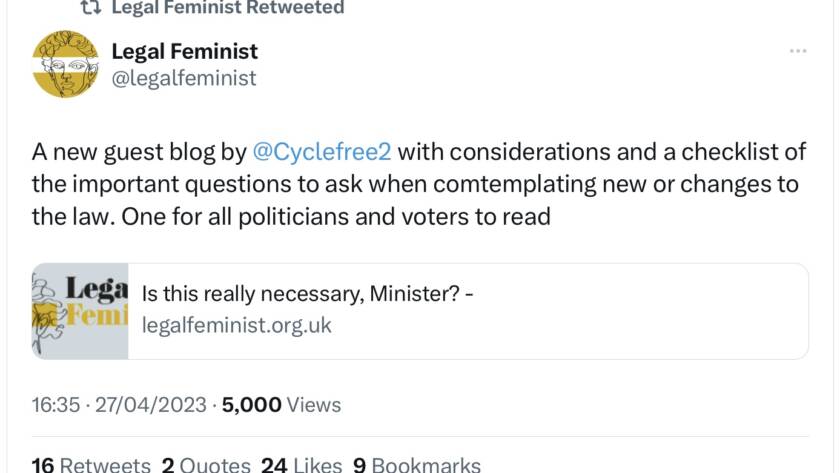
Is This Really Necessary, Minister?

Politicians are always inclined to fall for the “If all you have is a hammer, everything looks like a nail” fallacy. The almost instant reaction to any problem in the public eye or if you want to look serious about an issue or to show that you really really care is to propose a new law. 

In recent days, Labour have proposed a law making spiking a criminal offence, even though there are existing laws which could be used. They plan to ban “conversion therapy”, though it is wholly unclear what this term means. The Tories are trying to pass a law against small boats in the Channel. The Bill of Rights (introduced under Raab, dropped by Truss, reintroduced by Raab again) is back on Alex Chalk’s desk. 

This last Bill is a classic example of a solution in search of a problem. It has been presented as a necessary reform. In reality, there have – since 2010 – been 4 reviews, all of which found no “compelling evidence of a problem” or “viable proposals for reform”. The Bill has been eviscerated by the joint Parliamentary Human Rights Committee’s report – here. Even a previous Tory Justice Minister (Robert Buckland) said the proposed Bill was pointless and a solution to a problem which no longer existed, if it ever did.

This last comment goes to the heart of why so many proposed new laws so often achieve little – and can do great harm.

When should a new law be introduced? And why? 

Those wanting a change should show:-

  1. The mischief they seek to address or the improvement that is needed. “What is the problem to which this is the solution? Be  precise in your answer” should be the first two questions asked of any politician proposing a new law. Too often they are never asked. Or, if asked, the answer is no more than “Something must be done. This is something. Therefore we must do this.”
  2. What are the real causes of that problem? If the causes are not legal ones, a legal solution is not going to be the answer. What will it improve and how? Too often, a new law is doing for the sake of doing. Or more often appearing to be doing.
  3. Can this issue be addressed by existing laws or other measures? We have enough of the bloody things on the statute book, after all.
  4. Is the problem sufficiently serious to warrant change? Partly this is a matter of priorities. But some problems are ones which cannot easily be solved or at all, are inherent in the tensions between conflicting interests. A bit of realism to counter the “There should be a law against it.” tendency in voters and politicians is needed.
  5. Will legal change resolve or alleviate the problem? Will it create other problems instead?
  6. Is what is proposed a proportionate way of resolving the problem. Not all problems can be resolved or only at an unacceptable cost.
  7. What are the consequences, especially the unintended ones? Do they harm the interests of others? If so, how badly? Can these be easily mitigated? If not, is it really worth going ahead or are there other measures which might work better?
  8. Is this consistent with other legislation or initiatives the government is enacting? This may be unduly hopeful but some attempt at consistency and joined up thinking would be welcome.
  9. Finally – and critically – how is this going to be implemented / enforced? If there are no or few resources to back up the new intentions, what – really – is the point? 

Is a pointless / ineffective law harmful?

Does it matter? Yes. Pointless law-making – the passing of Potemkin laws –  creates or reinforces cynicism about politics and a disregard for the rule of law, especially when it is seen as ineffective. Above all, it diverts attention and effort away from practical and effective problem-solving measures.

The desire to be seen to be doing something often seems to be the only important consideration. Consultation is put forward as a justification. But too often consultation starts from the assumption that something must be done and avoids a clear-sighted analysis of what the problem actually is and whether anything should be done. Or, more cynically, a cover for unclear / unpopular proposals (“We are going to consult on these proposals” = “We know they aren’t popular but we’re going to implement them anyway.”)

It’s as if what matters most is not effectiveness but the appearance of busyness. Ironically, this simply creates more work for lawyers and judges to try to sort out the mess thus created, more material for politicians to grumble about, more cynicism among voters, more proposals – and on it goes. It’s law-making as Escher might draw it.

Leave a comment

They are still protesting

Last October I wrote this article – The Arc of History – about the protests by women in Afghanistan, in Iran and in Ukraine about what was happening to them in their countries.

All three countries have rather dropped out of the news in recent months. But the cruelty (often a particularly sexual cruelty) to – and oppression – inflicted on them continues and gets worse. In Iran, the authorities have deliberately aimed at faces, often blinding young women in one or both eyes. In Afghanistan women have been publicly whipped in the street. Women in Ukraine have had their children kidnapped and sent to Russia, a war crime for which the ICC have issued arrest warrants against Putin and Maria Alekseyevna Lvova-Belova, Commissioner for Children’s Rights in Russia.

Despite all this and worse, women, many of them young – and some men – are continuing to protest and defy the authorities responsible.

  • In Iran earlier this month, its Supreme Leader and the police’s commander threatened women with arrest if they took off their hijabs. The response was a lot of women publicly going out without their hijabs, often accompanied by male friends and relatives. One heartening aspect is the increasing number of men who have joined women in protesting against these diktats and fighting back against the morality police. Dishearteningly, however, months of protests have not loosened the regime’s grip on power nor its insistence on controlling its female population in this way or its brutality to those it arrests – including the summary hanging of those it deems guilty, after grotesquely unjust trials.
  • In Afghanistan, women continue to protest (see the picture above from a filmed protest in Kabul earlier this month) against their total obliteration from public life and from any ability to earn a living or have an education. The cruelty inflicted is only matched by the hypocrisy of Taliban leaders, many of whom are sending their own daughters out of the country to get the education they are denied at home.

    There is not much to be hopeful about. Perhaps the only conclusions we can draw so far are these: –
  • Dictatorships willing to behave oppressively and caring little for censure, whether domestic or foreign, can keep going for a very long time indeed.
  • Rights, once won or granted, can be taken away or lost. We must never be complacent – even in the West – especially about rights for women, which always seem to be something which have to be negotiated for, as if their grant was an immense favour to women and not something they are entitled to as of right.
  • Those who continue to protest, at great personal cost to themselves and their families, are immensely courageous. “We will fight. We will die. But we will take back our rights.” is what those women in Kabul are chanting.

    Whatever we can do to support them, however little it may be, we should. Even if it is no more than reminding ourselves and others that they are still there, still protesting, and letting them know that they have not been forgotten. It is not much, frankly. But it is better than silence.

Leave a comment

12 Good Men

In 2020 both Holyrood and Westminster toyed with the idea of suspending or otherwise restricting trials. Those proposals did not go ahead. Now the Scottish government is proposing a pilot of single judge trials for rape cases. The reasoning behind this proposal is set out here. I find such proposals troubling. The article below is what I wrote in June 2020 on the value of jury trials.

I loved Latin at school. My award for Latin poetry recital is carefully preserved and I remain mildly hopeful that, one day, it might even prove useful. Poetry aside, it was then seen as necessary to become a lawyer. For the first few years of practice those Latin sayings encapsulating legal rules became firmly lodged in my head. Then they were no longer compulsory, plain clear English becoming the rule. Quite right. But one saying seems particularly apt these days: Ex turpi causa non oritur actio – no-one can make a claim based on their own dishonourable conduct. More widely, it expresses the idea – or, perhaps, the hope – that people, governments even, should not be able to take advantage of the damage caused by their failings to do that which they would not otherwise get away with.

There is now a very real danger of this happening with trial by jury, a practice which goes back – in its essence – to Magna Carta. 

Juries have not always been loved. Blair tried to curb jury trials in 2003 and had to back down, Tories opposing him, their then spokesman saying: “Jury trial is an essential safeguard to ensuring respect for the criminal justice system.” Juries are not always loved by the legal establishment either, including some judges, those who think that the law is far too important and complicated an issue for ordinary persons, who are simply not clever enough to understand. It uses the complexity beloved by lawyers to justify keeping the whole process within this charmed, closed circle, a legal elite. It is an argument often heard in relation to fraud trials, conveniently forgetting that sniffing out dishonesty does not need a degree, that it is often some of the apparently cleverest people – formally anyway – who fall for some of the biggest conmen around. Understanding people is not a profession but something that all can do. It is precisely the introduction of the ordinary person’s view, the wisdom of a small crowd, which is the jury’s great strength and its value. To adapt an infamous saying: when it comes to guilt and innocence, you can have too much of experts.

Lawyers and judges can become so inured to what they see and deal with every day that they risk becoming cynical and world weary. As Chesterton put it: “the horrible thing about all legal officials, even the best….all judges, magistrates, barristers, detectives, and policemen is ……simply that they have got used to it”. What is just another case for a lawyer or judge is a potentially frightening and life-changing experience for the individuals involved: defendants, victims and witnesses alike. Juries are one of the best ways, for all their faults, of making sure that ordinary people are truly involved in one of the most critical functions of the state. They provide legitimacy, credibility and finality. And that group of 12 disappears at the end of a case, never to reappear, whereas judges and magistrates are around for a long time and hard to remove, no matter how perverse they may be.

There are other benefits too: the ability to tell the authorities when they are being oppressive (Ponting) – a real life version of the small boy telling the Emperor he has no clothes – and, of particular value these days, the involvement of minority groups often ignored by other parts of the justice system. The 2017 Lammy Review found that, by contrast with practically every other part of the justice and prison system, juries were the one part where there was no evidence of unfair or discriminatory treatment by BAME juries or to BAME defendants. The way juries had to operate (see page 34) – debate, persuasion, a collective decision rather than by one person – was one of the key reasons for this.

The current problems are long-standing and lie elsewhere: a 25% cut in real terms funding since 2010 for the Ministry of Justice; other cuts to legal aid and police funding; restricting sitting days to save money so that between 25 – 40% of Crown courts are unused; 260 court buildings sold in recent years, for instance. This has led to a backlog of 37,400 Crown Court cases in December 2019 (rising to 40,500 by end May), with trials happening well over a year, in some cases, as much as three, after charges are brought. Justice is being delayed mightily. It is not quite as bad as in 2014 when the backlog was ca.50,000 cases. But still disgraceful. The situation is even worse for cases heard by magistrates: in March the backlog was 395,600 rising to 483,700 by mid-May. Justice – imprisonment: these are key functions of the state. For the state to preside over their degrading is for it to fail at one of its most fundamental duties. It is demolition by deliberate neglect. 

None of this backlog and the consequent harm to defendants, victims and witnesses has been caused by Covid-19. The latter has not helped, of course, but only trials longer than 3 days have been postponed during the lockdown. No – the vast backlog and delays are a direct consequence of years of under-funding by the government. So if the government wanted to resolve such problems, it knows what to do: increase funding, reopen closed courts, have them sitting 5 days a week, build Nightingale courts etc.

Why the concern then? When Nicola Sturgeon suggested in April that jury trials in Scotland be suspended for up to 18 months, there was a furious reaction and not just from the usual legal suspects. A former Lord Chancellor and famously no lover of experts, Michael Gove, described it as “deeply concerning” and asked “is it wise to take this position on jury trials.” A very good question indeed. The Scottish government retreated. On 4 May, the Justice Minister, Chris Philps, told the Justice Select Committee: “There is categorically no question at all, under any circumstances, of the right to jury trial being removed. It is a fundamental right. It goes back centuries in our history, and it will never be removed at all.

That was then. Now we find the English Lord Chancellor suggesting just this. In order to create capacity, he is proposing either reducing juries to 7 or taking away the right to a jury trial for offences with a possible prison sentence of 2 years or more, replacing this with trial by a judge and 2 magistrates – the very same magistrates unable to deal with their current workload. (Apparently, hugely increasing their workload will increase capacity, which is why he favours this option.) Legislation is to be passed by 21 July and implemented by September.

  • He says these are the only choices. This is a false choice. 
  • He says such a change will be temporary only. Of course it will, like all those other “temporary” changes which become permanent when the immediate emergency has passed. When trial by jury is salami-sliced in this way, the pressure will be to continue further, not reverse the changes. 
  • He claims that this is necessary to increase “capacity” without taking the obvious steps to do so and without explaining how an already overburdened magistracy can help.
  • He provides no explanation of whether defendants will have an automatic right to appeal against convictions nor what the other effects of this change will be.

This is an old practice done by those who know the price of everything but the value of nothing: starve public services of what they need to operate effectively, then wield the axe by claiming they are no longer effective. It is being done dishonestly by pretending that the trauma of Covid-19 necessitates this. It is being done quickly and with little time for consultation, scrutiny or proper consideration of the implications.

Easy to think of this as special pleading by lawyers. It isn’t. Juries are one of the best, one of the oldest ways of involving ordinary people in one of the most important decisions there is: 12 life experiences, perspectives, opinions, voices able to assess the honesty, motives and actions of another, as we do every single day. Justice by the citizen is justice for the citizen. Trial by our peers is far too important for us all to be so casually dismissed out of expediency and to cover up the gross failings of the government itself.

It was Lenin who reportedly said: “Never let a serious crisis go to waste.” (Or, possibly, Macchiavelli.) A cynic or a revolutionary seem to be the guiding lights of this government. Is there anyone to ask: “Is this wise?

Those who view justice with the eyes of a bean counter are using Covid to destroy one of the institutions that works, that really does value the opinions of real people rather than simply uses “the People” as a prop for politicians’ egos. We are seeing its slow demolition, first by neglect, then by malice. Dishonourable indeed.

Leave a comment

WHY THIS?

Naomi Cunningham, a well-known barrister specialising in equality law, wrote an interesting post on her personal blog “A Blog of One’s Own” in April 2021 — Why This? In it she considers why, of all the debates about rights, gender reform is —

the one proposed change in the law that is — in many circles — simply unacceptable to oppose?

Why is this? And why has this issue has become such an important cause for her. It has led me to ask this too. This is my response.

The gender debate seems to me to combine two elements: belief and a fight about power. By gender debate I don’t mean the existence of gender dysphoria. What its cause is and how to treat it is a matter for experts and those with such a condition. People with it should be helped in every way possible to live full and fulfilling lives. No, what interests me is the way this has been conflated into and tied to a wider gender ideology — one which thinks that all have a gender which is different to sex, that it should be the way in which men and women are categorised and that this should be determined solely by an individual’s decision without any regard to anything or anyone else.

A new religion?

The desire for a belief system providing simple answers and clear moral certainties is eternal. GK Chesterton put it well when he said —

When men choose not to believe in God, they do not thereafter believe in nothing, they then become capable of believing in anything.

That impulse is a strong one, even in people and societies considering themselves secular and irreligious.

Believing that a man can turn into a woman simply by saying so (self-ID) has many of the elements of a quasi-religious belief system:

·       Belief is what matters not evidence, however scientific or strong.

·       The desire and willingness to reorder society or an important part of it on radically different lines.

·       It is Manichaean: the believers, the good guys, and those who don’t, the bad guys and can be called names (TERFS as the new heretics).

·       It is, much like all religions, very binary. The irony of a belief system apparently rooted in a love of diversity unable to accept the richness of human experience but determined to force transmen and transwomen into pre-existing categories is delicious.

·       Much like religion, it hates such ironies being pointed out or being laughed at.

·       The simple unchallengeable catechism: to be chanted but never explained. “Trans rights are human rights”, for instance. Yes, they are. One can equally say “Men’s rights are human rights”. Or — more daringly — “Women’s rights are human rights”.

So what. The questions are what are those rights? And how are they to be balanced against others’ rights.

An even more challenging question might be: are all demands rights? The unspoken assumption behind this catechism is that everything that is wanted (at least by this group) is a human right. This is an assumption which needs unpicking and more consideration than it is given. The apparent simplicity of the language, couched as it is as something self-evidently good, is designed both to obscure this and make any challenge difficult, wicked even.

·       So it is with the other half of the catechism: “Transwomen are women”. Transwomen are men who believe they ought to be women, that they are somehow in the wrong body and who want to live as if they were women. Or — to coin a phrase — “Transwomen are transwomen”. If this were how the issue was described, the debate would be very different. That it is not — through the deliberate choice of those promulgating the TWAW mantra — is key.

·       The warm feeling of the self-righteous convinced they are right together with the sense of belonging, even the sense of persecution if someone dares disagree.

·       The casting out of the heretics (being “cancelled”, even if sometimes overstated, is this century’s equivalent of Amish shunning).

·       The manipulation of language and the way some things cannot be said because they cause, allegedly, hurt and offence. (Let’s leave aside for now the question of whether hurt and offence should be forbidden.) This is the new blasphemy, cloaked in the language of politeness. But “misgendering” is not just about simple politeness. It requires the speaker to accept the belief system of the person so described. It is like asking an atheist or a Jew to accept the tenets of Christianity in how he or she sees the world and describes their own experiences, including when it conflicts with the evidence of their own eyes. It is asking them to lie. This is about power. And about a lack of respect, contempt even, for those with different views.

·       The use of violent language and, in some cases, justification of violence against unbelievers. This may not be by all those supporting self-ID but the fact that there is a sub-set of such supporters (usually male) willing to use violent language, threats and, on occasions, violent or threatening behaviour against women (mostly) should trouble the advocates of self-ID more than it appears to. Rather like other 20th century belief systems, an element of it is about violence and power and control. It is troubling that it may appeal because of these features, not in spite of them.

·       The increasing focus on children and ensuring that both their understanding and their experiences are shoehorned into a very particular understanding of human development, to the detriment or exclusion of any other understanding, including those based on science. Affirmation as Confirmation. It is rather reminiscent of the Jesuit motto about being given a child until 7 and having them for life.

·       There is even a priesthood of sorts. Established charities purporting to speak for all, granting blessings on those who follow the faith and indulgences, in return for cash, and increasingly intolerant of dissenters (see the Mermaids legal action against LGBA).

Who / Whom

It is a fight about power. The way the gender debate has been crafted seems designed to allow men to do what they have been doing for centuries: telling women who they are, how they should behave, what they can say and think. It allows them to exercise power over women in the most fundamental sense by saying that it is men — not women — who get to determine where the category of “woman” begins and ends and thereby what her physical boundaries can be. Self-ID — especially by a man as a woman — undermines (a) the idea that women and girls should have boundaries and decide for themselves what those are; and (b) the dictum — “No means No”.

But it is not just this. Men claiming to be women and thereby claiming access to women-only spaces pose a potential threat to women in the way that women claiming to be men and in men’s spaces do not. This is not just about definitions. It is about the use to which men’s greater physical power over women can be put, about the violence, often the sexual violence that frequently results from that.

TWaW or TWaTW

The fact that the debate centres around whether transwomen are women as opposed to how they can live as women is critical. If the issue were described as “TWaTW” it would become very much easier to think about what accommodations are needed — and by whom they should be made — to enable trans people to live full and fulfilled lives. What is interesting is why this has not been done, why the debate has not been about this but about (largely) the redefinition of “woman”. There is virtually no discussion about the redefinition of “man” to accommodate transmen. Nor any discussion about what accommodations men should make, whether for transmen or transwomen retaining male bodies (by all accounts the vast majority of them). That this is so is key to the way the debate has developed.

It avoids accepting — or even pointing out — that transwomen are men with male bodies who feel that they are women. It avoids considering the implications of transwomen having the male strength which male puberty gives them, something which cannot be undone no matter what changes are made to outward appearances (including surgical intervention). It avoids considering how such male bodied people might be accommodated in male spaces, in male sport, in male prisons, how men should seek to be inclusive, how transwomen can be protected from attack or violence from men and so on. Instead, the entirety of the debate is about what women should be forced to do and accept, how women must be inclusive and be made to be so, if they disagree. Attempts to exclude for good reasons — safeguarding — are described and dismissed as middle-class gatekeeping by a Scottish legislator. [1] It feels as if, at least for some, the whole point of the debate is to give men another excuse to control and bully women.

Can words hurt?

Look too at the offensive and abusive language which is often used against women who object or raise concerns: “bigots”, “TERFS”, “hate groups, “transphobia” (if you dare talk about women’s rights)and the threats of sexual or other violence. Vitriolic language is sometimes used by people on all sides of the debate. But there is something particularly threatening when men use violent language against women. They can — and have the power to — follow up on such threats. And often do. It is one reason why we have become more concerned about the use of such language and whether it is a sign of a propensity to commit domestic violence or abuse positions of power (see, the recent reports on misogyny within the police [2] and the recent convictions of two Metropolitan police officers for the use of such language about women, amongst others. [3]) (Vicious language used by women against men, while wholly wrong of course, does not usually or routinely have the same implications or create the same fears for men.) Violent language, threats of violence are used both to stop challenge and to punish those who dare to speak out.

Is it even a debate?

One consequence of the self-ID movement being a belief system based solely on a person’s feelings is that it makes it very hard to argue against it. Women’s groups marshal arguments, evidence and explanations of the legal consequences and it is all for naught. But as the late Christopher Hitchens put it:

You cannot reason a man out of what he hasn’t reasoned himself into.

It is no coincidence that it is to the law courts opponents have gone and that it is there that they have had some measure of success. [4] There arguments, reasoning and evidence matter. Beliefs do not. Or — rather — they are the start of the argument. Not the end of it.

The search for power and for power over others is at the heart of all politics and all conflict. It is often brutal and visceral and zero sum. That is why the combination of the language used and how the issue is described together with the imbalance in power between men and women make this such a difficult issue.

Why does it matter?

This is why it matters so much to many women. Why it matters to me. This strikes at the heart of who we are, who we can say we are and how we can live our lives. It goes to the very core of our identity. It goes to the heart of mine.

The language and structure of religion is very very familiar to me. The way it is used to support a world which limits a women’s ambitions is the world my parents grew up in and to an extent sought to escape from. I grew up in its shadow. I was given the tools, education and confidence to escape from it and do and be whatever I wanted. But I have also endured the sexual violence which men so often visit on women. When I was younger I was raped. I have not let it affect my life. Like many I did not report it. I could not bear to cause my family pain. I felt humiliated. I felt ashamed that I had allowed it to happen. I put it away in a box marked “unwanted memories”. It is not the only sexual assault I have had to endure — from groping to lewd language and indecent exposure. There is nothing special about this. Every woman I know has a similar story.

It is easy to say that identity and the risks of sexual violence are luxuries or unimportant, when so many are wondering how to feed / heat and house themselves. The accusation of triviality (Maslow’s Hierarchy of Needs is sometimes quoted) is a bit rich coming from political parties and lobby groups who have seemingly made this a legislative priority. It is apparently so vitally important that it must be pushed through at breakneck speed with little scrutiny but utterly unimportant when women want to talk about it.

But this ignores something fundamental. It was Paddy Ashdown, when High Representative for Bosnia-Herzegovina following the civil war, who pointed out that before the establishment of any democratic or other civil institutions, there needed first to be order and stability. Only then could the rest flourish.

A person’s identity and security in that identity are a bit like the order which a society needs before it can develop. They are essential to living any sort of good life. It is what growing up means — developing that identity and being comfortable in it, having it respected and understood by others and having the strength and resilience to deal with those seeking to undermine or harm it. Respect for women’s boundaries so that she is free to go about her life without having to worry about assault is essential. It is something men take for granted. Attacks on women’s identity, on what being a woman even means, on the very idea of boundaries undermine this. Women have had to fight so hard to be recognised as independent autonomous beings, to be able to act in ways men take for granted, to speak, to be listened to, to be seen as themselves not simply as the property of men or an adjunct to them or as those who are always expected to accommodate the wishes of others, to “be kind”, to be ‘inclusive”. And now we are being told that we are going to have to fight for this all over again because men, once again, are seeking to take away what is ours, what we have had to fight for — painfully — over decades.

What it used to be like

I started out as a barrister a decade before Naomi. I remember a time when male barristers would simply ignore women pupils, blank them, because they were of no consequence. Or treat them as ones to be persuaded into sex in return for vague promises of pupillage. I remember the condescension of the bank manager coming to my school to talk about finance and ask us if we’d seen coins, as if we’d come from an Austen novel. I remember my mother telling me of her sadness at not being allowed to go to university because that was “not the done thing” for girls when she was growing up. I remember being told by my Italian aunt not to boast about my A-level results because my male cousin, the same age as me, who had not done so well would feel bad. I remember being told that girls had to be womanly — wear pretty dresses and nice shoes and behave like a “lady”, whatever that meant. I remember the police at university advising women what to wear to avoid the risk of rape. I remember it being assumed that I must be a secretary working late — not the lawyer — when travelling home from the solicitor’s office where I learnt to be a litigator. I remember the boss appointing a male colleague to a more senior post without even opening it up for interview because he assumed that the man was more experienced and better for the role and I would not be interested, without asking me. I remember being at a meeting at the offices of a major fund manager and being told that there were no ladies’ loos on the executive suite because there were no women executives. The secretaries’ loos were in the basement.

Trivialities?

Maybe — but so indicative of a world which did not value women as it should have or tried to limit them to old-fashioned stereotypes. The world has changed since then. Not enough of course. A survey in my first in-house job showed that by every metric women were treated worse than men. 22 years later in my last full-time job I was the only senior woman in my department working full-time with a family. Women like me were still a rarity despite all the HR processes and equality talks. These changes did not come about naturally. They had to be fought for, often in the teeth of male resistance. I was of the generation which benefited hugely and had opportunities denied to previous female generations.

The turning point

Then in July 2021 I read the decision in the FDJ case [5] which said that it was legal to house a man, who felt he was a woman and had a gender recognition certificate, in a women’s prison despite him raping a woman prisoner, despite the risk of rape and despite the fear that this would cause women prisoners. That buried memory comes out of its box. In 2021, rape, the fear of it are an acceptable price for a woman to pay to accommodate a man’s feelings.

This is a human rights cause, apparently. It is bigoted to oppose it. The idea that a man who thinks he is a woman could be protected from attacks on him/her in a man’s prison with men doing the accommodating is not even up for discussion. [6]

The man in this case had a gender dysphoria diagnosis. But now a man’s right to change his gender — without any medical diagnosis, for any reason whatsoever — is to be made legal. In Scotland, if the Scottish government wins its case against the S.35 Order preventing it getting Royal assent. This right is to be granted to all men, even to those convicted of sex offences against women. All that matters are the man’s feelings, however unwarranted or malicious or frivolous or unjustifiable they may be. In 2022 in Scotland it is acceptable for a male sexual offender convicted of offences against girls and identifying as a woman, who attacks a man in a men’s prison, to be moved to a women’s prison. [7] Male prisoners must be kept safe. Women prisoners …. well, who cares? Or so official policy appears to be.

We are being told to agree to this to be inclusive, to be kind to others, to think of others first, to be accommodating, to avoid offence and hurt. We are told that all it takes to be women is to wear dresses, high heels and lipstick as if womanhood was merely a superficial costume to be put on and discarded at will. So-called progressives are behaving like my old-fashioned aunt. Women are being told to behave like good little girls again. If we don’t, we are verbally assaulted or threatened with physical assault, some of it in luridly sexually offensive ways. Or simply ignored or excluded.

No.

It is so tiresome, so wearying, so infuriating to have to go through this again, to be told that if we disagree or protest or ask about our needs, our rights, our demands, our boundaries, our concerns, the risks to us, we are being bigoted or selfish and that these are “not valid.

That is what I think is going on. That is why the debate about self-ID is so toxic and so important. Women are not being listened to. If it goes through, I fear that it will push back or eliminate many of the rights women have gained during my lifetime. I am seeing changes in attitudes already. I am seeing exemptions created specifically to permit women only spaces not being used for fear they will upset men. I am seeing inclusivity being used to exclude women from places they were previously free to treat as women-only. [8] It will affect not just me but my daughter — and her daughters too. That is why it matters to me.

Men with power bossing women around. This is a very old, very sour wine being offered in a new bottle.

Footnotes

[1] See what Karen Adams, MSP said about safeguarding during the debate in Holyrood on the Gender Recognition Reform Bill on 15 November: https://twitter.com/ForWomenScot/status/1592486669823139841?s=20&t=SDewjYoq7BmBca0HGsDvkg

[2] In October 2022 Dame Louise Casey’s interim report on misconduct in the Met following Sarah Everard’s murder was published — https://www.met.police.uk/police-forces/metropolitan-police/areas/about-us/about-the-met/bcr/baroness-casey-review/. The final Casey report on the Met was published in March 2023.

The report by the Chief Inspector of the Police on vetting, misconduct and misogyny in the police, published in November 2022 can be found here — https://www.justiceinspectorates.gov.uk/hmicfrs/publication-html/an-inspection-of-vetting-misconduct-and-misogyny-in-the-police-service/

[3] Two Metropolitan police officers (one current and one former) were convicted in September 2022 of sending grossly misogynistic and racist messages in a WhatsApp group shared with Wayne Couzens, the police officer convicted of the rape and murder of Sarah Everard in March 2021.

[4] The Forstater case is a prime example. See — https://assets.publishing.service.gov.uk/media/60c1cce1d3bf7f4bd9814e39/Maya_Forstater_v_CGD_Europe_and_others_UKEAT0105_20_JOJ.pdf

Another one is the case brought by For Women Scotland Limited against the Scottish government over its definition of woman for the purpose of the Gender Representation on Public Boards Act. See https://www.scotcourts.gov.uk/docs/default-source/cos-general-docs/pdf-docs-for-opinions/2022csih4.pdf

[5] See the High Court judgment — https://www.bailii.org/ew/cases/EWHC/Admin/2021/1746.html

[6] It is notable that the judgment does not consider whether it would be appropriate for a male bodied person who identified as a woman to be held in a men’s prison and, if so, in what circumstances.

[7] Katie Dolawoski, a male identifying as a woman, was convicted in 2018 of voyeurism and sexual assault of a girl and placed on the sex offenders’ register. In 2022 he attacked a man in Polmont jail and was transferred to the female estate at Cornton Vale. He has since been released; there are reports of him breaching the terms of his release on two occasions.

[8] One example is Hampstead Ponds in London. There are three: male, female and mixed. Transwomen insisted on being allowed to use the female ponds not the mixed ones. So now there is one male only pond and two mixed-sex ponds. There is no longer a female only pond. When women sought to use the male only pond to make a point, they were chased out.

Leave a comment

Let there be light

I came across this on social media. Stunning. A view across Ullswater from Glencoyne Head. It is painterly in the way it catches the light. You can imagine Turner painting such a view in this way.

The photographer is Paul Willson, an aspiring landscape photographer. 

One to watch.

View comment

The Cynic’s Dictionary

Sexual harassment: Boorish behaviour, unwanted by the target. Not to be confused with flirtation or courtship. Often perpetrated by people who have not recently looked in a mirror or who have forgotten their age or marital status.

Code of Conduct: Having some manners.

Witch-hunt: The process of making grown-ups accountable for their behaviour.

Addiction: Bad behaviour turned into an “illness”.

A clinic: A place where “addicts” go to, to hide from the media.

Abuse of power: Bullying. Soon to be classified as an “addiction

Inappropriate: Very popular word covering –

(1) Breaches of social etiquette, such as using fish knives to eat steaks.
(2) Language mistakes e.g. the use of “disinterested” to mean “uninterested”.
(3) Behaviour previously described as “wrong” or “illegal” or “criminal”.

Wrong: Description of behaviour which is either illegal or known by a majority to fall below widely accepted standards of decency. Implies responsibility by the person doing it. Now in high danger of falling into disuse.

Banter: Amusing social interaction between friends and/or colleagues. Not to be confused with bad or offensive language, which becomes “banter” when someone complains about it.

Apology: (1) A short form of words by which a person says sorry for behaviour which is “wrong” (see above). Traditionally starts with the 1st person singular and ends with the word “sorry”. In danger of falling into disuse.

(2) A long form of words by which someone appears to apologise while not in fact doing so. The non-apology apology requires focus on the victim’s reaction while also implying that it is both overegged and may not have happened.

There are many variations of this. Industries where bad behaviour is widespread are fond of adding to their apologies (variant no. (2)) a lengthy reference to all the good people in the industry; see Banking, Parliament, the Police, Journalism.

(3) The “Will this implausible excuse do?” apology: used by sulky teenagers everywhere. Now spreading to adults who should know better. See Diane Abbott who thought that saying offensive comments in a first draft was an adequate explanation rather than revelatory of what a person really thinks.

(4) Other popular excuses:

  • The culture has changed” – “I can’t get away with this anymore.
  • What might have been acceptable 10, 15 years ago” – “My lawyer drafted this.”
  • Parliament / the police / the CBI [insert organisation of choice] now needs to look at itself” – “Will this go away if we set up an inquiry and sack someone?”
  • Conduct needs to be improved” – “We must make sure not to get caught again.”
  • I have fallen below the high standards that we require of the [insert organisation of choice]“By the time anyone works out what this means this unfortunate affair will have been forgotten.”
  • I have reflected on my position” – “My wife / the PM / the Chief Whip has been shouting at me all weekend.”

Offence, the taking of: the best way of avoiding a debate and/or revealing you have no arguments. It is not actually necessary to be offended, just to say that you are.

The time for apologies is over (©Bob Diamond): The time when apologies (see “Apology (1))” should start.

Clarification: either

  • an admission that what you said before was completely untrue (in common parlance, a lie); or
  • an insistence that what you are saying now is what you have been saying all along, even though it is the complete opposite.

Shame: No known contemporary definition. Last heard of in the 1960’s.

We are going to consult on these proposals” – “We know they aren’t popular but we’re going to implement them anyway.”

We have not been consulted” – “We have not been agreed with”

Let me be clear” – “I’m going to be anything but.”

Full and frank disclosure” – “We don’t think they’ve got any more dirt than has already been published but are keeping our fingers crossed that nothing else comes out.”

A kangaroo court: any tribunal which decides something which the person under investigation disagrees with.

Any statement saying that an entity’s finances are fine and intended to reassure: usually the precursor to discovery of a fraud or insolvency.

An inquiry: A process by which an embarrassing story disappears from public view.

A report: What a person who had nothing to with the original events has to present to Parliament and/or the media many years later. See the Savile Inquiry Report. See also the forthcoming Grenfell, Post Office, blood contamination and Covid-19 reports.

Lawyers: The people who write inquiry reports. Also, the only people who read them.

Peerage: what the author of a report producing a satisfactory outcome for those commissioning it gets, entirely coincidentally, after the report has been finished.

Conclusions:  Usually written before the inquiry has heard any evidence.

Recommendations: What you find, if you read that far, in the Appendices to a report.

Working group: A group of people unable to avoid being tasked with the responsibility of coming up with suggestions as to how recommendations might be implemented.

The long grass: Where recommendations usually end up. See also “Inquiry

Lack of resources: The best reason yet invented for not implementing any difficult recommendations.

Lessons learned: Lessons which are never learned by those who need to learn them.

This must never happen again” – “This must never happen again during my term of office, at least not before I resign/retire and draw my gold-plated, index-linked, final salary pension or move onto an even more well-paid position.”

Whistleblowing: Something which is frequently talked about but not done anything like often enough. The equivalent of an “extreme sport” in some professions e.g. medicine, politics, finance.

Photo by Brett Jordan on unsplash.com

Leave a comment

The Scottish Question

Scotland is fast becoming to British politics what Ireland was in the 19th century: a country with endless, seemingly unresolvable, political grievances and issues defying easy answers. It has voted against independence but since 2007 has voted into power a party whose raison d’être this is. The current travails (today’s development a whistleblower about SNP finances claiming threats by the police, whose chief retired earlier than expected shortly before Sturgeon announced her resignation) are what almost inevitably happen when a party has been in power for too long with little effective opposition. This is something else which Scotland shares with Irish politics (the latter’s financial/political scandals over the years rival anything Westminster/the City has produced) and Irish society (see the various horrors resulting from the Irish Catholic church’s long stranglehold).

Now we have the latest Scottish issue – its legal challenge to the UK government’s S.35 Order under the Scotland Act (see here). Westminster is saying that the Scottish government has acted ultra vires and passed a Bill it has no legal power to do under the devolution settlement. Holyrood says that Westminster has misdirected itself on the Scotland Act and therefore has no legal basis for challenging what Holyrood has decided. The case raises interesting and novel legal issues; its political consequences are likely to make themselves felt in the run up to the next General Election.

What the challenge is not about

That a majority of MSPs voted for the Bill is not an argument against the S.35 Order. Rather, it is an essential condition precedent for it. The UK government cannot take action unless a Bill has been passed. Equally, that the Gender Recognition Reform (“GRR“) Bill’s provisions may, according to opinion polls, not be supported by the Scottish public is also irrelevant. The Bill’s popularity or otherwise – whether with MSPs or the public – is not what the case will be about.

What are the issues?

Two.

(1) Does the Bill impinge on matters reserved for Westminster under the Scotland Act? In particular, does it modify the law as it applies to the reserved matter of equal opportunities through the inter-relationship of the GRR Bill and the 2010 Equality Act?

(2) If it does, are there reasonable grounds for Westminster to believe that those modifications would have adverse effects on the law applying to equal opportunities?

If the answer to (1) is no there is, of course, no need to consider question (2). So Westminster has to win on both of these key points.

Who will win?

Only a fool would answer this, though a couple of retired Law Lords and Charlie Falconer have opined. The Scotland Act has not been tested in the courts; the interaction of the existing Gender Recognition Act and the Equality Act is not always clear, let alone the changes proposed by the GRR Bill. What tests will the courts apply to the Scottish government’s judicial review, especially in the context of a devolution settlement? The courts might well decide that any challenge to a decision passed by a democratically elected parliament should have to pass a high bar. Equally, if that parliament acts beyond its powers, how far need the court inquire into the reasonableness of the objections? The Scottish government has certainly made some interesting arguments: it says that effectively it can do whatever it wants in relation to gender reform, including repealing the GRA altogether in Scotland. This is an odd argument given that this would put the UK in breach of the ECHR (which would undoubtedly be ultra vires). It has also argued that Westminster should have told it how to amend the Bill during its passage so as to avoid a challenge, a curious position for a government so concerned with its own sovereignty and powers to adopt.

What next?

The Scottish courts will decide the issue first, though it is pretty much inevitable that the case will end up in the Supreme Court, whose President is Lord Reed, a Scottish judge. The court has taken a markedly more conservative approach in recent cases. For a comprehensive review of all aspects relating to the veto and challenge, there is an excellent research briefing lodged in the Parliamentary library here.

Timing

This is where it gets politically interesting. The case could take a year or more to get to a final resolution, in the run up to the next election. If the Scottish government loses how will this impact the SNP? Will it give them a boost – wicked Westminster interfering – or will it be seen another example of SNP overreach, imposing unpopular policies and wasting money? And how will this impact on Labour’s chances in Scotland? If the Scottish government wins, then it may raise the substantive issue of the balance between women’s rights and transgender rights in the run up to the election, something which Labour may not welcome, given Starmer’s recent comments on the issue. A defeat for Westminster would not be good for the Tories, of course, but they may not care if they are facing electoral defeat anyway.

Events

Then there is what is happening to the SNP. The spectacle of Scotland’s First Minister having to deny that the SNP is acting “in a criminal way” has a Nixonian feel. What else might happen? Will the current SNP government even be in place when the case is decided? Whatever the outcome, it will be an interesting case on devolution, the proper scope of judicial review and the workings of the Equality Act. Lawyers, if no-one else, are delighted at the prospect.

Photo by Alex Azabache on unsplash.com

Leave a comment

Side Passages

What to do with the side passage


Part 1

You know the one: not (seemingly) large enough to do anything useful in or with but a large enough space to allow storage of all sorts of “useful” stuff. At least that’s how it starts. The reality soon enough becomes storage of all kinds of stuff, most of it not useful at all and never found when needed. A mess. So some expand the house over it so that you can have more indoor storage. 

But I am here to tell you: forget that. This is part of your garden. It will, if you look at it, during different times of the day, get some sun. Shade too can be made beautiful. It can be made a place of joy. 

So this is what I did with the two side passages of our house. This first part relates to an unbelievably messy side passage, filled with all sorts of rubbish over many years. The passage is also sloped.

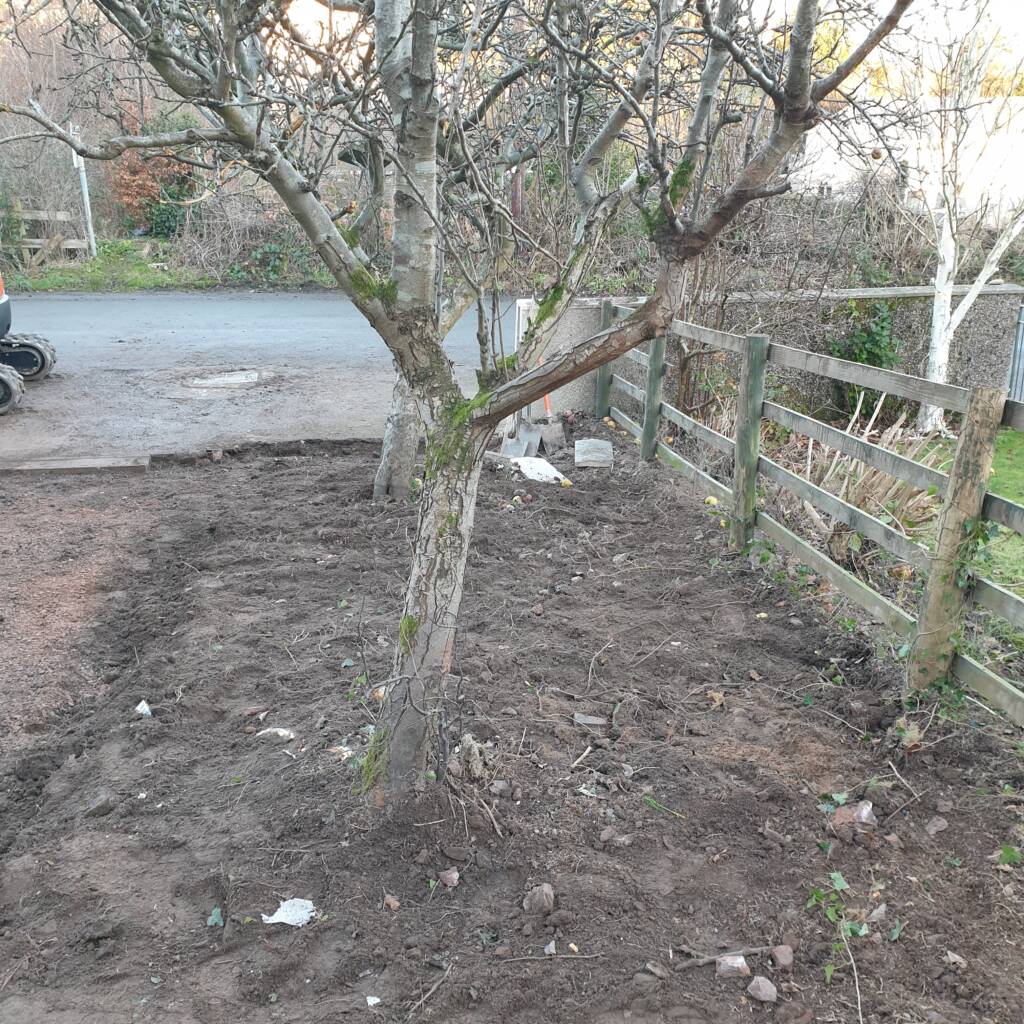
Clearing – of rubble, broken tools, rusted tools, bags of damp wood etc – filled a couple of skips. Then the very overgrown leylandii was dug up. What seemed dark and narrow actually turned out to be usefully wide and with much more light. It gets the morning sun which also warms the house wall.


At the bottom, two existing fruit trees remained: an apple and a pear tree. 


The old fence was taken down, slate tiles laid down and posts for trellis-style fencing put in.


I love trellis fencing. It lets in light; it is much easier to grow climbers up it (none of that faffing around with hooks and wires) and it provides views while giving some privacy. Two bin stores with green roofs were put in place and one solitary daphne – a magnificent winter-scented bush – planted.


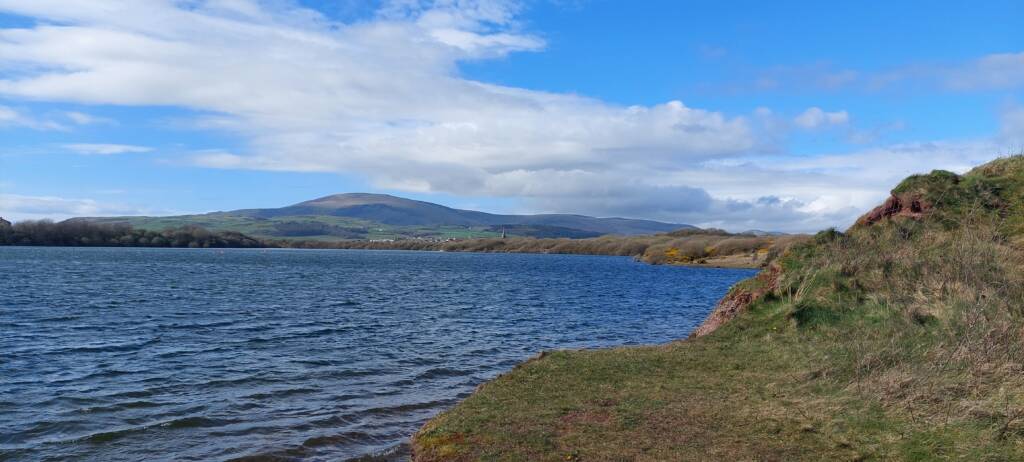
A view from the top of the passage. Next door’s hydrangea are visible and, in the distance, the hills on the other side of the Duddon estuary.


At the top of the passage, screens were put to hide the heat pump and provide a storage place for pots and working area. The space between the screens turned out narrower than I planned so it is a bit of a squeeze, an informal way of making sure that I don’t become unnecessarily plump. Madame Alfred Carriere roses are planted in pots to grow up the screens and over a pergola on the next level up.

This rose is an absolute star. A climber, she needs space. Makes no fuss and flowers for ever. I have had her in flower as early as April and as late as December.


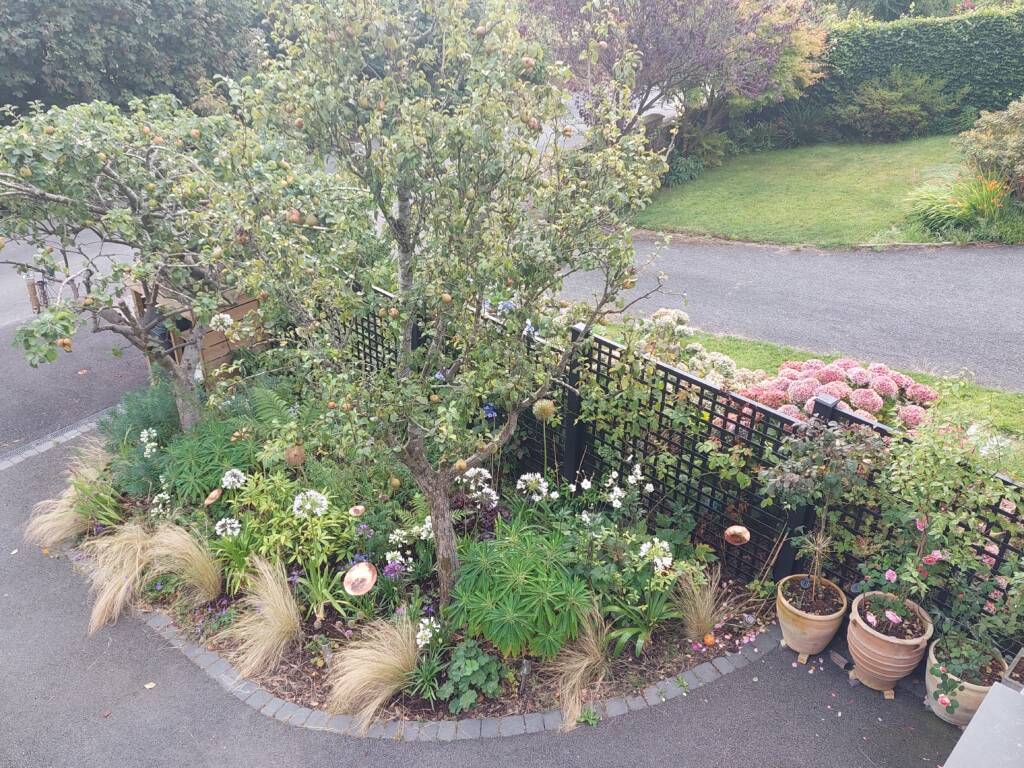
A view from above in summer 2021. A second daphne has been planted and grasses round the edge to catch the wind. 3 Gertrude Jekyll roses have been planted against the trellis. Alliums, agapanthus and alchemila mollis have been planted, along with euphorbia wulfenii and euphorbia mellifera.


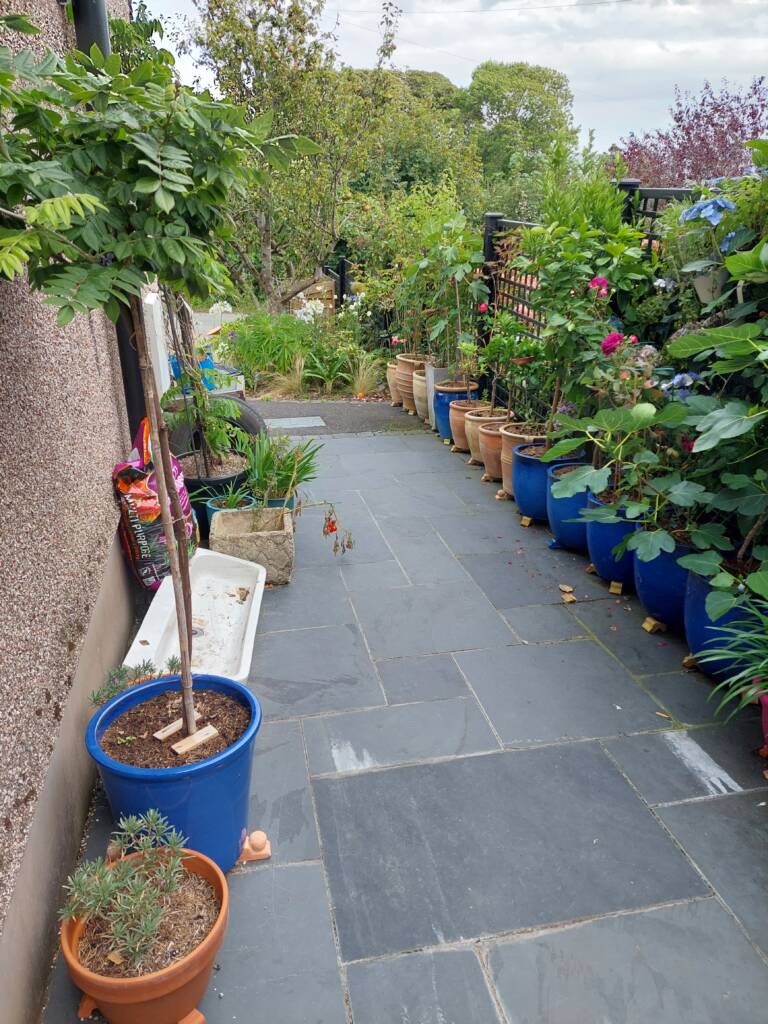
Further up the side passage I have indulged my love of pots and created a Mediterranean corner with more Gertrude Jekyll roses, lemons, limes, oranges, fig trees and vines. The passage is sunny and sheltered and protected from the wind. Wisterias have also been planted in the hope that they will grow up a not very prepossessing wall.


The citrus – with one exception – have survived the worst a Lake District winter can do. The first winter I brought them all inside the house. Bizarrely, one of the lemon trees which seemed to be OK when I brought it out again did not survive. The second winter of 2022-23 I did not bring them in and they are all thriving. 

Similarly, the green roofs have thrived. I planted two aloe polyphylla. They are meant to be hardy but have not coped with the recent endless heavy rain.


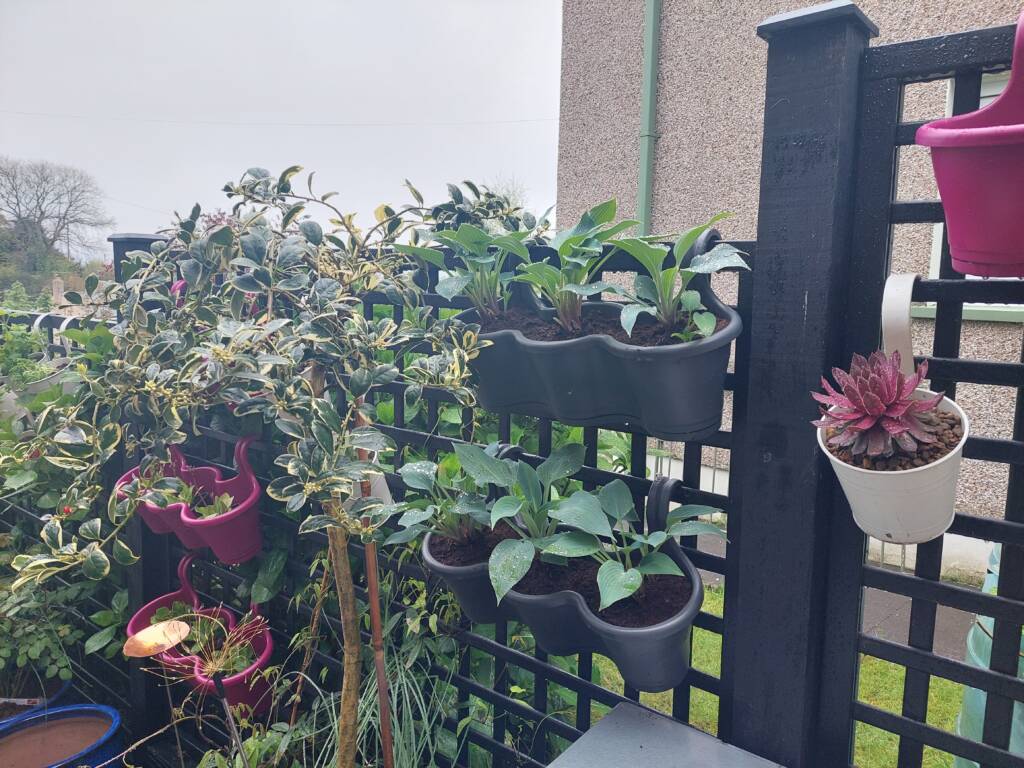
The other big advantage of trellis fencing is that it allows smaller pots to be hung on it: ideal for showing off plants like auriculas, hostas and herbs


After all this hard work, the really hard work began: planting hundreds of tulips, alliums and spring bulbs for my first full spring. Would they come up? Would they be stolen by squirrels?

So you can imagine my delight when this was the result the following spring.


Even the wisteria put on a good show.


And here

So there you have it: a dark, unloved and unused corner turned into a useful, fruitful and beautiful space.

Leave a comment