








The best single essay on financial misbehaviour was written not by a journalist, academic or former trader, but by a novelist and nearly 30 years ago: The Deficit Millionaires by Julian Barnes, that most pointillist and French of English writers. It is about Lloyds of London, the huge losses it suffered in the early 1990’s and how trusting Names slowly realised that their faith in a long-standing and well-established institution was utterly misplaced. Lloyds had been around for ever. It was part of the City’s furniture. And it was insurance, after all. How boring is that. How could anything possibly go wrong?
Well, with exquisite care and sympathy and the precision of a surgeon’s scalpel, Barnes shows us how. And the story is a surprisingly familiar one.
Even the modern new building housing the salvaged and totemic Lutine Bell and built by a famous “name” architect is part of the story.
Barnes eloquently shows how an institution believed to be “the highest name of honesty“, seen as part of a certain sort of honourable Englishness, around for three hundred and five years, a stalwart of the City, selling its services around the world, as venerable as the Bank of England and thought to be as safe, came to be seen, harshly but accurately, as “a cesspit of dishonesty“.
If only this had been published more widely than in a US publication and, later, a book of essays. If only we had paid more attention. If only we had learnt the lessons that were there to be learnt.
Everything that went wrong in the run up to the near collapse of the Lloyds insurance market happened again two decades later and led to the financial crash 15 years ago, even with the benefit of external regulation and control. Indeed, pretty much the same things happened in the lead into most financial scandals going back hundreds of years.
And, human nature being what it is, it’s a pretty safe bet that a version of all or some of these will happen the next time, may indeed be happening now. As we can see from the collapse of Silicon Valley Bank and Credit Suisse. The same behaviours will once again come under the spotlight when the the next scandal becomes known, with its inevitable backing chorus.
Why didn’t anyone see?
Why did no-one ask the obvious questions?
Why did no-one listen to the warnings?
Why, oh why didn’t anyone act?
As Parliament’s Intelligence and Security Committee put it in a different context, “it has been striking how some the issues which arose in [2005 and 2013] have also been seen as having been a factor in 2017. We have previously made recommendations in these areas, yet they do not appear to have been acted on.”
Scepticism. Curiosity. Asking tough questions. Learning lessons from previous events. Their absence is a regular feature of many incidents of misconduct, many crises, both large and small.
But ultimately, in finance, as in other sectors, it is those old-fashioned concepts – trustworthiness, integrity, honourable dealing – which remain as essential in 2023, and years to come, as they have always been.
(This article was first published in January 2020. It has been updated as at April 2023.)
Criminal justice, especially for sexual offences against women and girls, is much in the news lately. See Labour’s ad accusing the Prime Minister of being soft on child abusers, remarkable since Sunak has been PM less than 6 months, not enough time for a sex abuse case to be investigated let alone go to trial. Not to be outdone, during his election campaign, Scotland’s new First Minister, promised to uphold women’s rights. He showed how much he meant it by being photographed with a large pink heart and the look of one who, having forgotten his partner’s birthday and wedding anniversary, hopes that a vulgarly large card with the reduced price sticker removed will allow him back into the marital bed. It is also because of some recent cases and what they tell us about the reality.
The first is the sentencing of – and revelations about – a prolific offender such as David Carrick, a Met policeman. Aged 48, in February he pleaded guilty to 48 offences of rape and sexual assault since 2003 and was sentenced to a minimum of 30 years in prison. There were at least 5 earlier allegations – none of which were investigated, properly or at all – against him. The police are now investigating possible sexual offences he committed when he was 13. According to the judge’s sentencing remarks, he had a drunken abusive step-father, who was violent to his mother.
Meanwhile, in Scotland, Sean Hogg, aged 21, was sentenced to 270 hours community service after being convicted for the rape in 2013 of a 13 year old girl, after threatening her several times. 2022 Scottish sentencing guidelines state that custodial sentences should not be imposed on those under the age of 25, unless there is no alternative. This is based on scientific evidence suggesting that a person’s cognitive abilities do not fully mature until then. This and the need for rehabilitation are factors a judge can take into account, though he could have imposed a custodial sentence in this case. The sentence, widely criticised for its lenience, may yet be appealed by the Crown.
What might we learn from these two (and other similar) cases?
Labour has a point when it attacks the Tory government’s record on criminal justice, though the problems did not start in 2010.
What there is instead – in excess – is lots of politicians talking loudly about wanting to do “something” about (“halving” even! ©Keir Starmer) violence against women and girls, now handily reduced to the “VAWG” acronym.
But unless Labour – or anyone else – clearly says it will spend the money – lots of it – to repair this dismal state of affairs (and how it will be raised), talk and an acronym is all women and girls can expect. No party anywhere in the UK has any interest in having an effective, timely system which catches criminals, brings them to justice and provides redress for the victims. At best they might pass more laws but without the resources to make them work.
The real problem with Labour’s attacks – or any Tory counter-attacks – is not their unfairness, incoherence or multiple inaccuracies about investigations, trials and sentencing. It is that they are no more than “Tough on Crime” window-dressing, as the interviews of Lucy Powell and Emily Thornberry show (where was Steve Reed, Labour’s Shadow Justice Minister?).
Empty bluster. Put that on a poster and you have the entire next election campaign for all parties summed up.

“Lessons will be learnt”. How often do we hear this? If only. Lessons are not learnt: not by those who should learn them; not enough to prevent similar problems happening again.
Why?
1. The memory hole
If a few years ago, who remembers the investigation or report? Or that it might contain something relevant now? Gavin Williamson resigned over bullying allegations against MPs and civil servants. But no commentator mentioned the 2018 Dame Laura Cox report (1) into bullying within Parliament. It was promptly buried with no action taken. So here we are. Again.
2. This time it’s different
The 4 most dangerous words in the English language. Not true and too often an excuse for ignoring lessons painfully learnt.
3. Defining the question to get the answer you want
See Credit Suisse in trouble over Archegos, (2) a fund run by a man who, when running a different fund, was convicted for insider dealing. How did they get themselves comfortable? Well, by saying this was a different legal entity thus ignoring the character, history of the man in charge and the risks this posed.
4. La-la-la: I’m not listening. Or asking. Denying evidence, not making inquiries so as to avoid getting inconvenient answers, refusing to listen to those raising concerns, retaliating against whistleblowers are all too common. Believing what fits with your preconceived opinions commoner still. As is dismissing concerns as a “moral panic”.
5. Groupthink: With the latest fashionable cause, it becomes easy to ignore those asking difficult questions or challenging the proposals. Easier to go with the flow than be a member of the awkward squad, especially if retaliation is feared or threatened. (3)
Remarkably, the Scottish government has taken all of these routes in its response to those asking questions about the GRR Bill. Consider this by Shona Robison earlier this year –
“There is no evidence that predatory and abusive men have ever had to pretend to be anything else to carry out abusive and predatory behaviour.”
She went on –
“The evidence is critical in relation to this issue.”
Indeed. It is. She clarified –
“If we look at the evidence, the threat to women and girls comes from predatory and abusive men, not the trans community.”
Note the assumption that not only is there no crossover between predatory, abusive men and those claiming to be trans but that there can never be such a crossover.
The Evidence
Still, no evidence? Really? Let’s be kind and accept she was only referring to those countries which had brought in self-ID as planned for Scotland. The Scottish government is always keen to emphasise how in line with international best practice it is. So it must surely have looked at what the evidence actually showed. Yes? Alas, no — as seen in this summary of the international position by Murray Blackburn Mackenzie. (4)
It’s worth noting:
(1) the Scottish government has admitted that it has not found or done any research on the impact of self-ID laws on women in these other countries. (5) Always easiest to claim there is no evidence if you don’t bother looking for it, of course.
(2) In fact, there is evidence of significant problems affecting women, for instance, men ID’ing as women to obtain access to women in places such as prison. In Canada, the US, even Argentina where self-ID was first enacted in 2012.
Let’s look more widely. Is there any evidence in, say, the UK of abusive men pretending to be something else in order to abuse? Or using the cover of something fashionable or respected to carry out abuse?
– A celebrity famous for his charitable activities, say? Why, yes: see Jimmy Savile.
– Or an inspirational Olympic-winning swimming coach? Yes again — see George Gibney, one of many male sports coaches abusing those entrusted to their care. (6)
– What about the 19 IICSA Investigation Reports (7) into the multiple ways in which men abused their positions as priests, teachers, social workers, foster carers, sports coaches and so on to harm the vulnerable? An unbearable amount of evidence there.
– Too long ago, maybe? Well, in the last week the HMICFRS Report (8) into the police has detailed how predatory men have become policemen, using that position to abuse women, girls and children.
– What about Scotland? How about convicted sex offenders abusing loopholes allowing them to change their identity, (9) the essence of the proposed GRR Bill? Yes, this has happened.
– Or England? How about someone seeking to dupe a women’s refuge into letting a paedophile who claimed to be trans to stay there for 71 days. (10) Again, yes.
But these abusers are not from the trans community, might be the reply. Alas, there is evidence of men claiming to be trans and using that claim to gain access to victims. (11) Or to abuse victims then claim to be trans to avoid or mitigate punishment or gain access to women’s prisons where more victims may be found. (12)
What is not yet known — or not with great clarity — is whether those men who are either diagnosed with gender dysphoria or claim to be trans without such a diagnosis have the same rate and type of offending as other men or a higher or lower rate. Getting and understanding such evidence is surely essential before anyone can say that the “trans” community (however defined) poses no risk. Of that, however, there is no sign.
The scale of abuse by male predators is hard to assess. Not all is reported. But that there is overwhelming evidence, accumulated over decades — about how predators operate, how they gravitate to places where victims are found, how they put themselves in positions where it is hard for them to be challenged, how loopholes are abused, opportunities exploited — is undeniable. There is no sector, class, place or profession where it does not happen. There is no group of people immune from being predators. There is no basis for saying that men who are or claim to be trans cannot be — and are not — abusers.
Two facts are clear: overwhelmingly, sexual predators are men; overwhelmingly, their victims are females. The burden is surely on those proposing a reform allowing any man over 16 to change gender purely on his say-so to show why — and how — it will not be abused or exploited by those claiming to be trans.
But …. but ….
Two arguments are often used by the reform’s defenders.
(1) Equating trans people with predators is unfair and offensive.
It is no better than those who, opposed to gay rights, claimed that gay men were paedophiles. Current concerns are, therefore simply another unjustifiable moral panic.
A strawman. It is not that trans people are abusers by definition. Of course, they aren’t. Rather, there will be abusers claiming to be trans in order to commit crimes or otherwise gain some advantage. It is they who are being unfair to trans people by using them as cover to exploit the opportunities the reformers will enable. (13)
Second, see what IICSA’s final report says: allegations of a moral panic about child abuse allowed a culture of denial of what was happening, giving cover to abusers. (14) There were instances of paedophiles who used councils’ desire to increase “diversity” to get jobs where they could abuse children, jobs they would not have got had there been proper due diligence and a focus on what mattered — safeguarding. (15)
The same point was made in last week’s report on the police. The recommendations of previous reports were ignored, the police were largely in denial about the problems, when women officers reported concerns they were not taken seriously, other considerations prevailed and risk assessment was poor. As the Chief Inspector wrote: “The police must be much more sceptical of those who want to wear the uniform.” (16)
(2) “Ah, but men don’t need to use self-ID to carry out abuse”, say the reform’s defenders.
After all, these crimes were committed before self-ID is even legally blessed. Well, not quite true. But how does that help? If men have already been claiming to be women in order to commit crimes, avoid punishment or get a lighter regime, why wouldn’t that increase once self-ID is enshrined in law, with the legal consequences the Scottish government is right now claiming before the courts? (17) It is not just the police who need to be “much more sceptical”.
This rebuttal misses the point. Of course, predators don’t need self-ID to commit abuse. Sexual predators don’t need to become teachers, priests, sports coaches, entertainers, charity workers or anything else, either. But they do.
The key questions
The key questions — those the Scottish government has carefully avoided asking — are:
– Are there risks that this reform — and how it is enacted — could be abused?
– How great are those risks?
– What are the consequences and for whom, if the risks are realised?
– Does it prevent or limit challenge, an essential safeguarding requirement?
– Can the risks be mitigated or eliminated? If so, how?
– If they can’t, should the reform go ahead at all or in its current form?
The Lessons
Three important lessons from previous reports are these:
(1) Boundaries matter — whether physical, safeguarding procedures, vetting, due diligence, processes, legal requirements, conditions to be complied with, verifications or, in Matt Parr’s words, “scepticism” about why someone wants to join a particular group.
(2) Ignoring previous reports, recommendations and evidence will make problems much worse.
(3) Scandals happen when those boundaries are abolished, ignored, weakened or seen as secondary to some more important purpose: “diversity”, for instance, or the reputation of an institution or group, when challenge is made unacceptable.
In Chesterton’s words — in their haste to remove the fence, people forget why the fence is needed.
The final IICSA report says that years ago child abuse was not perhaps as well understood as now. It is not much of an excuse for behaviour which even then was wrong. But it may explain why it was not taken seriously as it should have been. The same can also be said of violence against women.
There is no such excuse now. It is unconscionable for the Scottish government to ignore evidence, to refuse to listen to women who have suffered abuse, (18) to refuse to acknowledge the possibility of risks let alone assess them, to take no steps to mitigate them, not to do the necessary research, to assert what they would like to be true rather than engage and explain.
If it continues to ignore the lessons of previous scandals and repeat the same mistakes, then the dismal cycle of harm to the vulnerable, scandal, outrage, investigation, report, apology and promises to learn those lessons will inevitably be repeated. This is bad law and even worse governance. Above all, it is an abdication of responsibility those in public office have to citizens, especially the most vulnerable.
Footnotes
(1) The report can be found here — https://www.parliament.uk/globalassets/documents/Conduct-in-Parliament/dame-laura-cox-independent-inquiry-report.pdf
(2) See https://barry-walsh.co.uk/same-old-same-old/
(3) See the First Minister’s response to the resignation of Ash Regan. And the decision by 8 SNP MSPs not to vote for or abstain on the GRR Bill.
(6) https://www.bbc.co.uk/sounds/brand/p08njhrm — this podcast details Gibney’s crimes over decades and their impact on his victims.
(7) The reports can be found here — https://www.iicsa.org.uk
(9) See https://www.scottishdailyexpress.co.uk/news/politics/snp-ministers-urged-close-sex-28360507
(10) See https://www.thesun.ie/news/9679107/transgender-paedophile-duped-staff-domestic-violence-refuge/
(11) See https://transcrimeuk.com
(13) Chapter 4 of the 2018 Morgan report on Islington Council is illuminating on how abusers seek to piggy-back on more respectable organisations, to the reputational detriment of the latter. See https://www.islington.gov.uk/-/media/sharepoint-lists/public-records/communications/information/adviceandinformation/20182019/20181107sarahmorganqcreviewreport.pdf.
(14) See the Background and Context section of IICSA’s Final Report’s Executive Summary: “The notion that child sexual abuse was ‘not harmful’ persisted into the 1990s and, in some professional spheres, responses to it were seen as ‘over zealous’ and characterised as a ‘moral panic’.” https://www.iicsa.org.uk/reports-recommendations/publications/inquiry/final-report/executive-summary
(15) See the 1994 White Report (https://islingtonsurvivorsnetwork2.files.wordpress.com/2021/03/the-white-report-redacted.pdf) and the 2018 report by Sarah Morgan QC on Islington Council (footnote 12)
(16) See the Times article by the Chief Inspector of the Police, Matt Parr — https://www.thetimes.co.uk/article/matt-parr-trust-is-badly-damaged-but-not-beyond-repair-z09gd56r3
(17) See the current judicial review by ForWomenScotland against the Scottish Government — https://forwomen.scot/18/07/2022/judicial-review-2/
Addendum
Since this was first published by LegalFeminist on 14 November 2022 (here) four events have happened which reinforce what I say in this article.
(1) The first is a statement by Karen Adam MSP during the debate on the Gender Recognition Reform Bill: “sometimes we say the word ‘safeguarding’ when actually it’s gatekeeping”. It is an extraordinarily misguided and ignorant statement to make, dangerous in fact. Undermining the importance of safeguarding is never right. If it is a choice between “inclusion” and safeguarding, the latter always comes — and should always — come first. It is worrying that a legislator should think otherwise.
(2) The second is the decision by the SNP and other parties to vote against an amendment to the Bill which would prevent registered sex offenders from obtaining a GRC and new birth certificate. Instead, they will support a scheme “for offenders to alert police if they made an application for a GRC”. One can only weep at such laughable naivety. An offender — a criminal — is someone who has already demonstrated that they have no regard for the law. Quite why Scottish Parliamentarians believe that such people will comply with a requirement to inform the police that they intend changing their identity I will leave you to ponder.
(3) The other two incidents are the cases of Adam Graham/Isla Bryson and Barbie Kardashian. The former is a convicted double rapist in Scotland who claimed to identify as a woman, was initially put into a women’s prison, then moved after an outcry. The latter is a man convicted of multiple sexual and violent offences, with a GRC under Ireland’s self-ID law similar to the GRR Bill. He has been described as Ireland’s most dangerous prisoner but has been housed in Limerick’s women’s prison. Both cases led to Scottish and Irish politicians tying themselves in knots trying to avoid admitting that such instances were the inevitable consequence of self-ID laws.

Happy Valley, Line of Duty, The Bay, The Gold, Broadchurch, Inspector Morse, Endeavour, Unforgotten, Life on Mars, Ashes to Ashes, Cracker, Vera, Prime Suspect, Bodyguard, Luther, Criminal, Heartbeat, Inspector George Gently, Between the Lines, Foyle’s War. The view we lap up, given the preponderance of TV police dramas, is of basically good hearted, if understandably grumpy, policemen (and the occasional ballsy policewoman) doing their best for us. If they occasionally stretch or break a rule or two, well it’s all in a good cause. They are the good guys.
Meanwhile back on Planet Earth, on 17 March a former Met police officer was jailed for sharing with colleagues as “banter” a photo of two men having sex with a decapitated woman’s body. Is it any surprise to read in the Casey report that, while the Met was trying to encourage whistleblowing, others were telling colleagues to delete their WhatsApp messages.
The report is long and detailed; its contents appalling. They are – if anyone had paid attention to all the previous reports on the Met in the last few years – entirely unsurprising. The only surprise is that it needs to be said, again and again and again, at ever shorter intervals. We are not talking about 1 or 2 rotten apples, not barrels of rotten apples, not even rotten orchards. We are well into salted earth territory.
It is best summed up by what Louise Casey herself said this morning: “It’s an organisation that is long on hubris and quite short on humility.” It is “completely in denial“. She politely said that the current Met Commissioner, Sir Mark Rowley, gets it. But does he? His reaction was to get himself into an argument about whether he accepted the full findings, about whether the force’s failings were “institutional” or not. For God’s sake Mark! Today is not the day to be making such arguments, even if they were worthwhile (they’re not). How the hell do you think you come across? His tin ear was as nothing compared to the wholly inadequate, tone deaf and empathy-free response from the Home Secretary with a statement that should have been torn up as the useless first draft it was. Cameron is at a bit of a loose end at the moment. Couldn’t they have drafted him to write it? One thing he was good at was doing proper apologies for dreadful behaviour – including that of the police (at Hillsborough, in case anyone thinks bad police behaviour is confined to the Met).
Perhaps the most shocking aspects of the report are the examples: one of the worst is the revelation that evidence from rape cases was put in broken fridges, so full and so badly maintained that the door couldn’t be shut, the evidence was contaminated and had to be thrown away. No wonder one police officer is reported to have said that rape is now effectively decriminalised. The other is the report of a policeman masturbating in a shared changing room in front of colleagues. No wonder no-one was bothered at the reports of David Carrick’s or Wayne Couzen’s behaviour. We have an organisation mired in ethical blindness. Even poor Sir Mark admitted as much when he said that he was so busy with his job as Assistant Met Commissioner a few years back that he did not speak up about bad behaviour he saw. There you have it. The Burke quote about why evil triumphs personified.
Broken fridges and evidence thrown away. The police sending out questionnaires in high profile investigations (Partygate). The police breaking the law when getting search warrants (Operation Midland). This is a force which has lost a sense of professionalism, which no longer knows how – or cares – to do its job properly. A police force which cannot be bothered to keep evidence properly is not fit for purpose. Yes – it shows a contempt for women. But if they weren’t doing it in these sorts of cases, why would anyone think they are doing good investigations in other sorts of crimes? It is the lack of professionalism from which all the other problems stem: the sexism, the racism, the homophobia, the corruption, the obstruction (the Morgan report), the law-breaking and other multiple failures (Operation Midland & the Henriques report). No professional police force should tolerate the sort of behaviour described because people who behave like that are not going to do a good job even if faced with someone they can’t taunt, insult or disregard. The prejudice is both a consequence of – and leads to – incompetence. Both are both fatal to good policing. The danger of the responses to this report is that they will focus on the prejudice and not on the incompetence. No amount of EDI training or flag-waving is going to change that (see the Stephen Port murders) if you have officers who should never have been employed or are useless at what they do. All it does is give a comforting but superficial ethical veneer and change nothing substantive.
So if we don’t want superficial veneers, what next? We have one example of a police force which has had to change utterly: the Police Service of Northern Ireland. Use that as an example. Starmer was a lawyer heavily involved in those changes. This is one area where his experience if wisely used could really make a difference.
Some suggestions:
Coming up with best practice is not hard. Rolling it out and embedding it is. So the Met will need relentless outside pressure and persistent hard work, tough leadership and good communication internally. Do they have the people who want to make it better and are willing to do the necessary? That’s the cadre Rowley needs to find. And fast.
This report ought to be a near-death experience for the Met. And other police forces. It is a chance for it to change for the better. If not now, when?
A thought experiment
Take a religious group – something like Opus Dei, for instance. What might it do if determined enough? Let’s imagine.
Finally, imagine that many of the organizations where Opus Dei do this are state or state-funded organizations – the police, local authorities, government departments, grant-giving bodies and health authorities. They sign up to its creed, use its language, promote its symbols and congratulate themselves not just on not being anti-Catholic but on being proudly pro-Catholic, pro-Opus Dei.
Reasons for worry?
You’d think, wouldn’t you, that this is a bit odd. You’d be concerned at how a particular ideology was being spread without anyone else having a say. You’d be concerned that this seems to put the rights, interests and views of one group above those of others. You’d worry that it appears to be distorting or misinterpreting equality legislation. You might even wonder at the number of law firms signing up, thinking they’d be well placed to understand the law without the need to rely on non-legal lobbyists. You’d worry that the normal space for disagreement about aims and means was being squeezed out if any disagreement or challenge or questioning was described as “hate” and those expressing such concerns as “hate groups”. Above all, you’d worry that this creates a conflict of interest between what such organizations are legally required to do for all citizens and what they have agreed to do to satisfy Opus Dei and maintain their position in its league tables.
You don’t, of course, need to imagine any of this because it is happening now. Substitute Stonewall for Opus Dei and it pretty much describes how Stonewall currently operates.
The consequences
Those state organizations which sign up to Stonewall’s schemes have created multiple conflicts of interest: between themselves as employers and different groups of employees and between their public duties and their legal obligations to all citizens. They have blurred the distinction between a body carrying out public functions under existing laws and campaigning lobbyists. They have failed to recognise that such conflicts of interest exist. They have failed to consider the creation of a perception of such conflicts of interest, even if that was not their intention. They appear not to understand the problems arising when a body implementing the law acts as if changes desired by a lobby group advising it had already happened. Since they have not understood any of this, they have taken no steps to eliminate or mitigate such conflicts of interest.
This is why we get the usual cycle of some unacceptable action or comment, protest, panic by the organization concerned, withdrawal of the original comment/action accompanied by an apology blaming it all on an underling/a mistake and assurance that whatever happened was not in line with their “values”. The fundamental underlying problem and how to address it seems to pass them by entirely.
The police
Nowhere is the existence of such conflicts of interest more troubling than in the police. The police enforce the criminal law. They have significant powers over us. They have a duty to police “without fear or favour”. They need not just do this but be seen to do this. The reality of bias, the perception of a bias are damaging to proper policing. Such conflicts of interest risk damaging the rule of law and citizens’ faith in it.
This has been made more acute by three factors:
(1) Police misunderstanding their obligations as employers under equalities legislation.
(2) Confusing their obligations as an employer with their outward-facing public service obligations.
(3) The police’s approach to non-crime hate incidents.
Equalities laws and discrimination
Discrimination against police officers from minorities has understandably led to counter-measures. But what the police appear to have forgotten is that the obligation not to discriminate applies to all its staff. It does not simply apply to one group with a strong lobby behind it. In following the diktats of one lobby group, the police risk behaving in a way which discriminates, whether directly or indirectly, against others. For an excellent, detailed explanation of why – and the risks involved -, see Naomi Cunningham’s blog – https://www.legalfeminist.org.uk/2021/02/01/submission-and-compliance/.
Public duties
This approach has extended to its public-facing duties, as a direct result of the reach of Stonewall’s schemes. The training of staff according to Stonewall’s views will inevitably affect how they carry out their duties towards the public. More explicitly, Stonewall’s schemes expressly cover “service users”. For public bodies, this means us. It is astonishing and worrying that any public body – let alone the police – should think it appropriate to allow a lobby group to dictate, influence or advise on the performance of its public functions. The police’s sole purpose is to enforce the criminal law. When it needs advice, it should obtain this from expert criminal lawyers. If it needs advice on complying with equality law, it should obtain this from expert equality lawyers. What it should not do is obtain advice or training from – or be influenced by – a lobby group primarily acting for only one of the groups it polices. What is even more worrying is that in all the time the police have been part of Stonewall’s schemes, it appears not to have obtained legal advice on whether doing so creates a conflict of interest or the perception of one and whether, if so, this creates a risk in how it carries out its public duties.
Non-crime “hate”
The final point relates to the police’s approach to non-crime hate incidents. One might ask why the police are involved at all in matters which are not crimes. Whatever the reason, they have got themselves involved in what Lord Moulton described some 90 years ago as the “realm of manners” – that space between the law at one end and free choice at the other.
They have allied themselves closely with one lobby group and adopted its view on matters where there are both differences of opinion, a changing scientific context and legislation and case law different to what the lobby group believes or wants. In so doing, the police have put themselves in a position where those who disagree with Stonewall’s position can have little confidence that in any incident involving such matters the police will be – and be seen as – compliant with the law, not overreaching their powers and impartial.
This last point was seen in the Miller case where the Court of Appeal held that police guidance to record non-crime hate incidents –
“is plainly an interference with freedom of expression and knowledge that such matters are being recorded and stored in a police database is likely to have a serious ‘chilling effect’ on public debate”.
A year later, the College of Policing is proposing (apparently on legal advice) guidance allowing transgender officers to search those of the opposite sex to that of the transgender officer. This appears to be a breach of the relevant PACE provisions. It is, however, consistent with Stonewall’s view that a man who believes he is a woman is one and so should be allowed to carry out an intimate search of a woman. According to reports, the guidance also appears to suggest that a refusal by a woman or request for a female officer could be classed as a hate crime. The underlying assumption appears to be that intimate searches of the public are a service which, say, women should not deny to trans-identified male officers. This is a topsy turvy approach to police compliance with a law, one brought in after miscarriages of justice and police misbehaviour to ensure that evidence is properly collected without a sexual assault being committed and with proper regard for the dignity of the person being searched who is, it should be remembered, innocent.
We’ve been here before
The police being beholden to groups with an agenda is not a new problem. In Northern Ireland ever since its establishment, the RUC was seen as the explicitly anti-Catholic enforcement arm of a “Protestant Parliament for a Protestant people”. The bias was real and ultimately fatal to the rule of law there. More recently, the issue of Freemasonry raised similar concerns. During the 1960’s and 1970’s, concerns about corruption in police forces arose because of a perception that Masonic officers were putting the interests of fellow Masons above those of the force as a whole or their obligation to obey the law. Membership of a secret organization was eventually seen as creating a conflict of interest between a police officer’s duties and his obligations as a Mason. There is an echo of this in the way that Stonewall’s agreements with members of its schemes are not made public on the grounds of commercial confidentiality, despite the obligations they place on public servants.
Now
This time it is not whether individual officers may have a conflict of interest. Rather it is that police forces – by making themselves beholden to Stonewall’s agenda through its schemes – are explicitly putting themselves in a position where one cannot be confident that police decisions aren’t distorted by their membership of those schemes. For instance, how can women arguing for single sex spaces facing a demonstration by those demanding they include transwomen have confidence in policing of such a demo by police trained by those arguing the latter and turning up in a car painted in Stonewall colours? How can someone objecting to a potential breach of PACE be confident that they won’t be unfairly charged with a hate crime or have a non-crime hate incident recorded against their name if the police force has signed up to guidance permitting this?
How can one have confidence that the police – or other public authorities (see, for instance, the latest furore over the withdrawal of an Arts Council grant to a lesbian organisation opposed by Stonewall) – will not, in part (maybe unconsciously), be influenced by their desire to please Stonewall? One can’t. There is a clear conflict of interest. There is certainly a perception of one. The police should never have allowed this to arise. Nor should other public authorities. Or private bodies, for that matter. But at least there we have a choice. We do not with state bodies.
It is long past the time for them to stop outsourcing their thinking to – and seeking to comply with the requirements of – lobby groups. If such bodies won’t act, the government should intervene. Conflicts of interest are the sine qua non of all scandals. This one is no longer even hiding in plain sight.
(This article was first published by LegalFeminist on 15 December 2022; see here and here.)
“That men do not learn very much from the lessons of history is the most important of all the lessons that history has to teach.” (Huxley)
As with history, so with investigation reports. On the Today programme, Mark Rowley, Met Commissioner, said 100 officers were on restricted duties “because frankly we don’t trust them to talk to members of the public”. 500 officers were subject to misconduct investigations plus another 3,000 who also could not be deployed because of injury, mental health problems or inadequate performance. 10% of the Met is neither use nor ornament. He complained, understandably, about the 100 officers, “It’s completely mad that I have to employ people like that as police officers.” Quite.
Still, no-one made the Met employ them. They were chosen. By a force which should know how to investigate and ask questions. So how did they get in? It’s usually better not to hire inadequates than complain about the difficulties of getting them out when you later discover they’re useless or crooks. Surely – surely – the Met was rigorous when hiring?
Go on. Guess. There is, as always, a report, specifically, the recent HMICFRS report. This details a quite shocking catalogue of inadequate, inconsistent due diligence, vetting, pre-employment checks, and a system for hiring police officers in forces everywhere which is, bluntly, unfit for purpose. Little wonder criminals have been hired, men with a record of domestic violence, with links to criminal gangs and so on. The lack of vetting and checking continued after employment. Joined up thinking was missing; warning signals ignored. The police were blissfully oblivious of the importance of knowing basic facts about those seeking to join, of the importance of character. They didn’t even manage to tick boxes, such as they were.
The report details the consequences: a culture of abuse of power, misogyny, sexism, discriminatory attitudes, bullying, harassment, women not listened to, corruption and a breakdown in trust. Couzens was not a one-off. It was inevitable that he – and far too many like him – would get to wear the uniform and abuse the powers going with it because, as Martin Parr, the Chief Inspector put it, the police were not sufficiently “sceptical of those who want to wear the uniform”. Curiosity is a much underrated – and much needed – virtue.
This report follows swiftly on from others on police culture this year: a Home Office inquiry,(still to report), the Dame Louise Casey report, the Charing Cross station report by the IOPC (9 separate investigations) and 2 other HMICFRS reports in March and September this year on the Met. There have been prosecutions and convictions. More are expected. Rowley is asking for legal changes to allow him to get rid of bad police officers. What about the Met’s disciplinary processes? If of the same standard as their vetting, little wonder they have problems. Curbing the powers of the Police Federation is also long overdue.
But the most shocking aspect of this report is found in the Introduction, Section 2. There was a 2012 report on the abuse of police powers to perpetrate sexual violence. With 32 recommendations. In 2017, yet another report which found that the 2012 report had been ignored as had various others. And in 2019: another report – “Shining a Light on Betrayal: Abuse of position for a sexual purpose” said that progress was far too slow.
So the problems of abusive policemen grew, got worse and here we are – with 5 reports in one year saying the same damn thing again, a frustrated Met Commissioner and an under-performing force, in special measures, having to take the steps which should have been taken long ago, under both public and financial pressure and with one hell of a job to rebuild public trust.
If only the police had paid attention to the earlier reports. If only they had implemented their recommendations. If only the Home Secretaries (Mrs May, Ms Rudd, Mr Javid, Ms Patel) and Police Ministers (Damian Green, Nick Herbert, Nick Hurd, Kit Malthouse) then in place had insisted on this being done.
If only – a motto for our times.
It is not just this aspect of police culture where this is happening. The Henriques report after Operation Midland has been ignored. (There was even an HMICFRS report on how slow the Met was in responding to that report.) So has the Daniel Morgan report. The College of Policing has finally been told to make changes to its guidance on non-crime hate incidents a year after the Court of Appeal ruling in the Miller case. Meanwhile, it has drawn up guidance on intimate searches which potentially breaches S. 55(7) of PACE (such searches can only be by an officer of the same sex as the person being searched. It says it has legal advice that its new approach is lawful but won’t share it.) This is not just a matter of who searches whom; if the law is broken any such search may, prima facie, be assault and anything found might not be usable in evidence. Given the police’s all too frequent willingness to ignore the law (see, for instance, the police acting unlawfully over the Everard protest), a large dollop of scepticism about the College of Policing’s pronouncement is advisable. This too is an outfit needing a rigorous review and challenge. Women – whether in the police or outside – are often those suffering most as a result. But all are at risk and affected.
Mulish obstinacy has too often been the police’s response to criticism. As bad has been the inability of Police Ministers to hold the police to account. Why should they? They refuse to hold themselves to account and ignore reports in the same way. See the 2018 Dame Laura Cox report on bullying in Parliament, its contents likely echoed by the soon-to-be written report by Adam Tolley KC on alleged bullying by the Justice Minister/ex-Foreign Secretary. Will the current Police Minister, Chris Philp (bizarrely reprieved by Sunak after his short inglorious stint as Chief Secretary to the Truss Treasury) insist on all the recommendations in these reports being implemented, in full, by when and tell the police top brass they can whistle for any praise, baubles or bonuses unless this is done?
The time to implement a report’s lessons learned is as soon as possible after the report is published – not years later – and after yet more reports. This is the one lesson which should be learnt. But won’t be. If we could only sell our ability to write endless reports, ignore them and write the same reports again, multiple times but a bit more angrily, the country would soon have a growing, profitable industry to pay for our increasingly useless services.
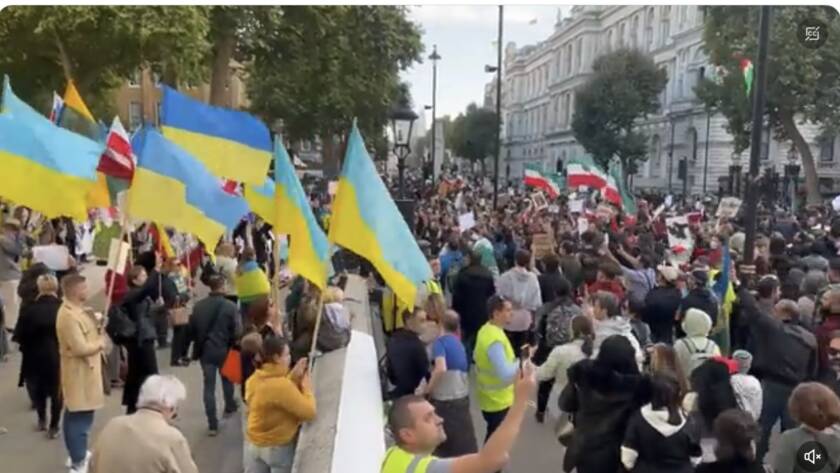
Those words of Millicent Fawcett are echoed by what we saw on the streets of London yesterday. A pro-Iranian women march met up with a pro-Ukraine one, both chanting “All together we will win.” A large screen in Piccadilly Circus displayed the motto “Woman, Life, Freedom” in solidarity with Iranian protestors. Lovely to see, but no courage is needed to do this in Britain.
Brave Ukraine does look as if it is slowly winning – or at least has stopped losing. If it does expel Russia, without this triggering a wider or more catastrophic war, it will be a significant boost for democratic values – in Europe anyway. Whether those values will extend to Russia is far more uncertain. The odds are against. It will likely retreat into a prolonged sulk, waiting its turn to try again, whether under Putin or another leader. With its authoritarian rulers, military humiliation, failing economy, corruption, oligarchical larceny and many of its educated young fleeing, it is a country ripe for revolution – though whether that happens and, if so, in what form is unclear. Little reason to be hopeful.
What of Iran? And Afghanistan? Yes – Afghanistan: more than a year after the Taliban took over, ordering women back to their homes, Afghan women are still protesting – against being denied an education – despite being threatened with guns, beheadings, beatings. The courage those women show should shame us, especially as they know the outside world will not help them, has given up on the country, and has done little to help those to whom promises of refuge were made. The UK’s Afghan Citizen Resettlement Scheme, designed for Afghans at high risk and announced with fanfare last September, has yet to bring anyone to the UK. The approximately 10,000 Afghans already here came prior to and during last August’s chaotic evacuation.
BBC News recently reported on the treatment of pregnant woman and their babies in rural Afghanistan. Rates of death are high, the treatment poor despite heroic efforts by the remaining female doctors and nurses and the occasional male doctors allowed to help. No new female doctors or nurses are being trained of course. So, as the segregation continues and professional women disappear, women and girls treated as little more than than their child-bearing organs, will live, suffer and die in unimaginably cruel ways. It is sex-based oppression in its purest – and most evil – form.
In Iran, protests against the death of a 22 year old Kurdish woman, following her beating by the Morality Police, have spread across cities for three weeks now, joined by other women and some men. Women are cutting their hair, burning their hijabs and and chanting for freedom. They want regime change not just the removal of oppressive clothing laws. (There have been similar protests by Kurdish women in Syria.) These women are brave: if they are not killed they risk imprisonment, torture and rape. Will they succeed? The odds are against them. It is not the first time there have been protests against the Iranian regime but still it carries on. It is perfectly willing to crush protestors; any concessions will be the minimum necessary to maintain their grip on power.
The arc of history (to misquote Martin Luther King – he was referring to the moral universe) does not always bend towards justice. Decades ago Afghan and Iranian women lived much as we do in the West. Rights once granted can be taken away. People may fight hard for their freedoms but there plenty of people – often men – who will fight equally hard for their freedom to oppress others, especially women. And they usually win. As Germaine Greer put it: “Women have very little idea of how much men hate them.” Too sweeping? Yes. Unfair? Possibly. But look at the first steps the Mullahs and Taliban took when they gained power: reducing the age of consent to 9, erasing pictures of women, ordering them to be covered up, stopping them working, going out and being educated. Look at the rapes of Ukrainian women by Russian soldiers, condoned and encouraged by the army and other Russians. Nor should we be complacent about the rights we have in the West. See the US and the Republican Party’s obsession with controlling women’s rights over their own bodies.
What a waste it all is. All those women and girls with all their minds, creativity, thoughts, desires, skills and talent crushed, with all that they could create and bring to society, confined to their bodily functions, even when this harms the society around them and the men and boys in it. The one thing any society can indubitably do to grow, develop and provide a good life for all its people is to educate and free and empower women.
I offer no happy ending. We cannot – and will not – intervene. We can offer what practical help and refuge we can. We should honour the promises we have made. We can listen to them and amplify their voices. We can at least remember their names: Mahsa Amini, 22, murdered for showing a stray lock of hair. RIP.

Financial scandals have the same features and failings occurring, repeatedly. What is concerning is to see these in a very different setting: the debate over trans self-ID, specifically, the Scottish government’s proposed GRA reforms.
Financial Lessons
At the heart of all scandals are conflicts of interest and self-delusion: believing what you want to be true and fitting facts to your belief.
The City’s 1987 Big Bang abolished restrictive barriers to facilitate competition. What this ignored was the resulting creation of ever larger financial institutions, creating multiple conflicts of interest between institutions, their clients, between clients and between different business areas. Internal Chinese walls tried to manage those conflicts. Self-regulation and — post the Guinness, Maxwell and Barings scandals — light-touch regulation were meant to do the rest. They did not work.
Why? Financiers deluded themselves into believing their own publicity — the myth of “star” traders, that they had discovered a new paradigm which meant that they were now able to manage risk so effectively that they could take more of it on, doing away with previous controls. They thought themselves so essential to the economy they could do pretty much what they liked. Politicians supported them in this delusion because it suited them. Finance lied to itself and others when problems arose: these were the proverbial “one or two” bad apples, not representative, it was unkind to tar everyone else with their brush etc. It did not correctly identify the risks it was running so did not deal with them properly or at all. We are all still paying the consequences (Note 1).
The law was clear enough. But the prevailing culture undermined it. Ethical blindness developed. When law and culture are at odds, it is usually the latter which prevails. Social contagion and conformity are more effective at determining behaviour than the strict letter of the law.
Several dangerous practices resulted:
Much has changed in recent years. The focus is on properly identifying, understanding and managing risks, closing loopholes (if one exists it will be used), on trying to avoid the creation of conflicts of interests and, where these are inevitable, managing them properly.
There have been two important changes above all:
There will always be bad actors. To think otherwise is naïve. And dangerous. Trying to root them out is playing Whack-A-Mole. But that steps must always be taken to prevent the former operating and risks becoming real are not in doubt.
GRA Reform
The debate is centred on trans people and their human rights, without ever stating what rights are missing. It assumes: (1) anyone should have the right to change gender; (2) only the needs of those wanting to do so are relevant. What is not asked is ask why anyone should. Nor whether everyone should. Nor what the impact on others may be.
The reform removes the requirement for a medical diagnosis (partly because of long delays getting one). Anyone over the age of 16 born or living in Scotland can change gender by making a self-declaration — with no verification of any kind. This is presented as a simple upgrade rather than a fundamental recasting making it something very different. (It is the equivalent of turning an obscure product designed for a limited purpose into a highly risky instrument traded by those whose motives may be self-serving or malicious.)
It repeats finance’s most serious mistakes:
Both of these are dangerously misguided, unsafe assumptions which do not survive a moment’s contact with reality.
The consequences are similar:
“There is no evidence that predatory and abusive men have ever had to pretend to be anything else to carry out abusive and predatory behaviour.”
This is an extraordinarily ignorant statement. If there is one thing we know about sexual predators, it is that they will use whatever loopholes and opportunities exist, including pretending to be what they are not. Ample evidence confirms this (Note 5).
This statement is a classic example of saying what you wantto be true, what you have to believe to justify what you wantto do. It assumes both that trans people, as a group cannot, by definition, contain bad actors and that bad actors will never abuse a loophole or pretend to be something they aren’t. It is not a statement of fact. But of belief. It is self-delusion on a colossal scale.
This self-delusion — both about the nature of the reform and the absence of risks arising from it — bakes dishonesty from the start into the proposal and consultation process. That lack of honesty — about what you are doing, about the harm that has been caused and the potential risks, about the need to balance the rights of different groups, about the need to protect the most vulnerable if matters go wrong — means that, eventually, just as in finance, problems will arise.
But their cost will not be counted in money but in real harm to women.
Notes
Note 1: For a fuller description of City behaviour see http://www2.politicalbetting.com/index.php/archives/2017/01/20/cyclefree-asks-are-banks-the-new-unions/
Note 2: The FT’s account of the Wirecard scandal is riveting: an example of a fraud, whistleblowers and the extraordinary legal and other lengths the fraudsters went to to stop the FT’s investigation, aided by the German regulators who did not want to believe that their “superstar” digital bank was less than it seemed.
Note 3: The Cass Independent Review of Gender Identity Services for Children and Young People is at Cass Review — Independent Review of Gender Identity Services for Children and Young People (independent-review.uk). Its interim report was published on 10 March 2022.
Or see https://www.thetimes.co.uk/article/sex-offenders-free-to-abuse-children-after-changing-id-bpdlx59p0.
See also paragraphs 13 and 14 of the High Court judgment on the lawfulness of the policy allowing transgender women convicted of sexual or violent offences against women to be housed in a women’s prison — https://www.bailii.crg-bin/format.cgi?doc=/ew/cases/EWHC/Admin/2021/1746.html&query=(4198/2019 This sets out the information as at 2019 as provided by the Ministry of Justice.
Note 4: See the submission to Parliament’s Women’s Equality Committee about Swedish research into offending patterns in transgender women prisoners who have surgically transitioned.
Note 5: See IICSA reports — Reports & recommendations | IICSA Independent Inquiry into Child Sexual Abuse
This post was first published by LegalFeminist on 14 June, 2022. See here.
Photo by Dainis Graveris on Unsplash
When an organisation in trouble loses its leadership, there is a tendency for the new management to embark on a reorganisation. This is usually a mistake. It’s not that reorganisation isn’t needed. It’s rather that it should not be the priority. It destabilises and distracts from the work which is needed.
So it is with the Met. There are big questions to be asked about its responsibilities, about whether counter-terrorism should be hived off, about how fraud is tackled and so on. But these need reflection and consultation and, ideally, cross-party consensus. And, crucially, they are not at the heart of its current problems. Those problems relate to its leadership, its culture – not just its attitudes but its inconsistent level of competence and professionalism – and its apparent inability or unwillingness to deal with the far too many rotten or incompetent officers within it.
Its two immediate priorities should be these – and in this order:-
What does a good culture look like? What should the process of change focus on? A huge topic but these elements are essential:
– Leaders at all levels who take responsibility, who do not seek to excuse, who know how to say sorry and mean it, who understand how the force is viewed by the public and why and can communicate effectively to the ranks why change is needed. They need to get officers to realise for themselves why behaviour needs to change, to enthuse them about why this matters, about why it will help them be better officers. This is about something more fundamental than simply following yet another procedure.
– Proper due diligence and thorough vetting both before recruitment and throughout employment. Remedying poor due diligence now on officers currently employed will be necessary.
– No tolerance of minor misdemeanours.
– A culture of “Speak Up” and an understanding that turning a blind eye, having misplaced loyalty to wrongdoers is unprofessional, wrong and dangerous – and will be punished.
– An effective training system and continuing professional education. That training must not be simply about not being rude to or about gays and women and minorities. It must be about professional competence – it is the lack of this which allows the former.
– An effective disciplinary system.
– A way of really learning from mistakes. Lessons learned has too often become a meaningless cliche. But if done well it is vital. What it means is accepting that mistakes will happen, catching them early and treating them as learning opportunities not as something to be PR’d away.
Action this day. They will need a team of senior leaders below the top whose sole focus, at least initially, is on this. They should start even before the new Commissioner is in place. Listing the weaknesses in procedures and procedures and the suggested recommendations from the numerous reports over the last few years will provide a detailed and worthwhile To Do List and a plan for action. They can start on this right now.
Asking the impossible? No. It has been done – in finance. (Well, in some parts anyway.) It is more prolonged and painful the longer it is left. It can feel like a distraction from an organisation’s main purpose. It will lead to the Met facing more bad headlines as the carpet is rolled up and the nasties uncovered. But without it, it can’t even begin to do its job. The Met will have little chance to rebuild the trust it needs to fight crime if it does not make a public start at putting its own house in order.
Cressida Dick’s main failing was that she never really understood this. Sadiq Khan’s was that he left it far too late to take action. Even now he gives the impression that it’s only the failings identified in the recent IOPC report on Charing Cross Police Station – bad language and attitudes – which need addressing. They aren’t. He may have been unbothered by the Morgan Report or the Stephen Port scandal or the Operation Midland failings but they are far worse. His job now is not to take one well publicised step then disappear. His – and that of the Home Secretary – is to keep the pressure on the new leadership over the years to come, if a defensive, often obstructive and mulish organisation is not to revert to its comfort zone. Meanwhile, politicians, the public and police can start the process of deciding how best the Met’s various responsibilities should be carried out. Whatever those decisions, a Met which has started taking the steps identified above should be in a better position than it is now.

Just before Xmas 2021 the Court of Appeal gave its judgment in the Harry Miller case. This, together with the Supreme Court’s Elan-Cane decision earlier that month, impact some of the most sensitive issues in society at present: free speech, hate crimes and the role of the police, self-identification and the role of judges under the Human Rights Act (“HRA”). These rulings provide — if taken — some guidance on sensible next steps and a corrective to Dominic Raab’s claims that the HRA has led to over mighty judges and needs amending in the ways he has recently suggested.
Self-identification
Elan-Cane’s claim was simple: born female, they were distressed by their body and had had a mastectomy and hysterectomy to remove visible and internal sex organs. They did not have or want a Gender Recognition Certificate but considered themselves non-binary. In consequence they wanted ‘X’ on their passport. They felt demeaned being forced into a M/F choice, a distress which should be alleviated by allowing them this alternative. The appellant claimed the ECHR gave them this right. If not, the court should create it using the Human Rights Act. Ooh! Controversial. The claim was dismissed. Why?
First, the court said that information was collected for reasons which had nothing to with individuals’ feelings about themselves. The latter were irrelevant. Collecting accurate information about individuals did not cause them harm or demean them.
“The purpose of providing that information is not to inform HMPO as to the applicants’ feelings about their sexual identity, and the applicants are not being forced to lie about those feelings.”
In 32 words, the court politely rejected the narcissism inherent in the appellant’s claim. Why? After all, how can it possibly affect others if a person calls themselves what they feel themselves to be in a private document?
The court had an answer for this too, one that should be obvious to all but the most acutely solipsistic. Identity documents are not private. Nor can they be viewed in isolation from their legal/administrative context or the use to which they are put. They are relied on by others — the state, other entities — when performing their legal obligations: verification of identity, taking precautions against fraud, ensuring security, providing accurate statistics. Their usefulness therefore depends on being both factually accurate and consistent with how other similar information is collected and recorded.
Above all, there is a need to have coherence in a country’s administration and law. The court explained at length the many laws and public services dependant on male/female categorisation and, of necessity, the need for factual accuracy in such categorisation. It also pointed out the need for a fair balance between the competing interests of an individual and the community. The public interest in having data be factually accurate, consistent and recorded in accordance with the law outweighed an individual’s desire to express their feelings about themselves.
Free speech or hate speech?
Onto the Harry Miller case. Mr Miller is a retired policeman who wrote various tweets on the gender/sex topic, which others thought transphobic. A complaint was made to the police. He was not prosecuted for them, though the police did visit him on various occasions and purported to advise him on what he should/should not say in order to avoid further complaints. (The police’s behaviour was criticised by the court in other legal action brought by Mr Miller.) His tweets were recorded as “non-crime hate incidents” in line with police guidance set out in the College of Policing’s Hate Crime Operational Guidance. Miller claimed this guidance was unlawful on various grounds, one of which was that it unfairly impinged on the right to free expression. In particular, he objected to the advice to record an incident as a “hate” incident purely on the basis of another’s perception (who did not need to be the target of the tweets) regardless of whether there was any inquiry into the incident’s truth or evidence to support the “hate” allegation.
Why should this matter if there was no prosecution? Well such incidents can be disclosed by the police on enhanced criminal record certificates, needed to be teachers, social workers, carers etc. So what the police disclose matters.
Did it matter if the police simply recorded the incident and there was no disclosure? The court accepted that the police had a right to record all sorts of matters as part of its policing duties — an assumption which may itself be open to challenge — but this right was not unqualified.
In particular, what of the right to free expression, a right generally accepted in English law and expressly protected by Article 10 of the European Convention of Human Rights? The court considered this an extremely important concept — not just for journalists (most cases under this Article of the Convention related to states seeking to limit journalists’ activities) — but also for private citizens expressing their view within the law, especially on controversial matters of public interest.
The Court of Appeal referred to what the European Court of Human Rights stated in Handyside v The United Kingdom:
“Freedom of expression constitutes one of the essential foundations of a [“democratic society”], one of the basic conditions for its progress and for the development of every man. Subject to paragraph 2 of Article 10 …it is applicable not only to “information” or “ideas” that are favourably received or regarded as inoffensive or as a matter of indifference, but also to those that offend, shock or disturb the State or any sector of the population. Such are the demands of that pluralism, tolerance and broadmindedness without which there is no “democratic society”.
Did the Guidance interfere with the right to free expression? Yes, said the court. Police guidance to record non-crime hate incidents “is plainly an interference with freedom of expression and knowledge that such matters are being recorded and stored in a police database is likely to have a serious ‘chilling effect’ on public debate”. This was because the sort of speech considered within scope was very broad indeed with a very low threshold, without the need for any evidence of either hate or hostile motivation before being recorded. Further, the vast majority were never investigated. In effect, the police were being encouraged to record as non-crime hate incidents, incidents “which are, to put it shortly, non-crime non-hate incidents” and doing so without any regard to peoples’ rights to free expression. The court stated that the Guidance would need amending though it left this to the College rather than spell out precisely how this should be done.
What does this mean?
There is much in these cases, more than can be summarised here. But some general points can be made:-
1. Individual perception and feelings are not everything. Feelings do not override facts. Nor the need to comply with the law.
2. An individual’s demands do not, of themselves, create a legally enforceable right. The demands of the collective — whether the state or other affected individuals or groups — also need to be considered. One of the curiosities in these debates is that those most keen on asserting the rights of a favoured group are often hyper-individualistic in wanting a member of that group’s demands met unconditionally and absolutely and reluctant to accept that other groups or the state may have different or competing interests.
3. Factually accurate data is essential to an understanding of risk, effective risk management, good research and sound policy-making.
4. Debate on matters of controversy will necessary involve saying things others disagree with. Disagreement, even when it upsets the state or other groups, is essential for the pluralism necessary in a democracy. In a democracy a stance of “no debate” is absurd. This does not make such disagreement or difference of opinion, however strongly or crudely expressed, either phobic or hateful, even if it goes against the consensus. Those who rush to categorise opinions they dislike as “offensive” or a phobia would do well to acquaint themselves with JS Mill’s thoughts on the topic — “He who knows only his own side of the case knows little of that.”
5. There appears to be confusion within the police: about the difference between intelligence and evidence and the uses to which they should be put; about the difference between behaviour which may be dislikeable or unfashionable and that which is criminal; and about what the police’s relationship with alleged victims and alleged perpetrators should be. The police seem to place more emphasis on recording matters, regardless of whether they are crimes, than in investigating them properly or at all. In so doing, police forces risk making themselves a vehicle for matters which are more properly the subject of public debate than for law enforcement.
What next for the police?
These are matters which some police forces seem unwilling to understand. There are many reasons for this, too many to go into here. In part, it is because it is so much easier to record an incident than it is to investigate it to the level required. Criminal investigations, if well done, are hard work. In part, it is a result — triggered by the Macpherson Report on the murder of Stephen Lawrence — of a desire to appear righteous, on the side of those who have been badly treated in the past by the police, to have the right values. These are not bad aspirations to have but they need to be accompanied by real substance and clear thinking. Too often they are not. It’s as if what matters most is not goodness but the appearance of it.
Look at the Met’s scandalous failures in its investigation of the 4 murders of young gay men by Stephen Port. Of what use or comfort were the Met’s rainbow flags and attendance at Pride events in such a case?
Or take Police Scotland who have decided to record a male alleged rapist as a “woman” if the male rapist “insists”. (Note how the police have moved seamlessly from concerning themselves with the perception and feelings of the victims of crime to those of the perpetrator.) According to Police Scotland, doing so is in line with “their values”. This may very well be so, though it would be illuminating to know quite what those “values” are. But it is not in line with the law, which says that only a male (including a woman who has legally/physically transitioned to being a man) with a penis can commit rape (though women can be guilty of aiding and abetting). It also ignores S. 20 of the Gender Recognition Act which requires birth sex to be recorded not the acquired gender when it comes to gender-specific offences such as, well, rape. It is also likely to conflict with the evidence given by — and perception of — the female victim, whose perceptions and experience do not appear to concern Police Scotland. What confidence can she — or anyone else — place in a police investigation which appears from the start to be biased in favour of the alleged attacker. (One wonders what else Police Scotland would do if the accused “insists” — destroy evidence or close the case, perhaps.)
What are we to make of crime statistics collected on such a basis? A small number of male sexual offenders classified as female (gender) can have a hugely distorting effect on the statistics for crimes committed by women (classified by sex). How can any sort of sensible risk assessment be made or anti-rape policy developed? It does not matter on which side of the debates on these topics anyone is. The very minimum needed to inform any debate, let alone policy decisions, is fact-based information consistently collected in accordance with the law.
It is not just the police who need reminding of this: the Office for National Statistics had to be judicially reviewed in relation to its advice on the sex question in the 2021 census (it proposed allowing people to answer on the basis of their preferred gender identity despite there being a separate gender question).
The police may have been in the firing line in the Miller case but the principles set out in it and the Elan-Cane case apply to other public authorities too.
The Home Office would do well to insist that the police collect information about crimes, such as sexual offences, on the basis of fact and existing law and that this is done consistently across all forces. A beady eye should also be kept on the College of Policing to make sure that the Guidance really is changed to reflect the Miller judgment. The College of Policing has form in ignoring judicial pronouncements it disagrees with. See its reaction to Mr Justice Henriquez’s recommendations following the police’s multiple failures in Operation Midland. Legislation is planned. This too will need careful watching.
Judicial overreach?
What of Mr Raab, the Justice Secretary? He wrote a book arguing that there were serious flaws in how the Europe Convention on Human Rights had been implemented into English law by the HRA. He now proposes changes to it. These have been severely criticised by the joint Parliamentary Human Rights Committee, amongst many others. He also wants to limit the power of the courts to judicially review government decisions. He should perhaps reflect on the value of judicial review, as shown by these two cases.
He might also reflect on what the Supreme Court stated in the Elan-Cane case when it declined to create a new right under the HRA, as urged by the appellant:
“…in the United Kingdom law-making is generally the function of the legislature. If the Human Rights Act were to be interpreted as giving judges the right to find breaches of Convention rights even where the European Court would hold that UK law was in conformity …. there would be a substantial expansion of the constitutional powers of the judiciary at the expense of Parliament. Parliament is unlikely to have intended to effect such an encroachment upon parliamentary sovereignty when it enacted the Human Rights Act.”
Is there anything in that with which he disagrees?

Aberfan
The BBC has recently produced an outstanding — if necessarily harrowing — podcast about the Aberfan disaster and its aftermath. Distressing as its contents undoubtedly are, it is required listening. The facts of the tragedy are well-known: on the hills outside Aberfan, a mining village part of the Merthyr Vale colliery, coal slurry and waste were stored on various tips. Tip no. 7 was on ground served by various streams, some of them underground. This and the tip’s increasing instability were known to the National Coal Board (“NCB”). Warnings were given but despite this and the fact that it was next to a primary school and residential houses, nothing was done. On the morning of October 21st 1966 it collapsed onto the school and nearby houses, killing 116 young children and 28 adults. A whole generation of children was wiped out. In a close-knit community the effect was devastating — not just for those losing children — but the survivors and those who witnessed the tragedy.
What compounded the tragedy and the continuing sorrow was the response of the authorities — not just in the immediate aftermath — but for years later, a response which combined a refusal to accept any responsibility, defensiveness, arrogance, callousness and an extraordinary lack of basic human empathy. Some examples will suffice:
· Right from the very day of the tragedy the NCB did everything it could to avoid accepting responsibility, with the Chairman, Lord Robens, stating that no-one knew about the streams. This was a lie. The Board did know. It simply ignored this. Its response to previous requests for the removal of the tips was to threaten the mine’s closure.
· It continued denying responsibility until forced to accept it under pressure from intense cross-examination by counsel for the families.
· Despite the findings of the official inquiry which found the NCB and nine individuals wholly responsible for the disaster, no-one was prosecuted nor was the NCB fined. No other action was taken against any of those held responsible.
· Without informing the families, let alone getting their consent, subjecting children who had survived to psychiatric interventions designed not to help them but to justify reducing the amount of compensation paid if they could be classified as “sane”.
· Accusing those parents who petitioned for compensation higher than the £500 originally offered as “seeking to capitalize” on the tragedy.
· The Charity Commission queried the amount of compensation paid to families from the Disaster Fund, a fund created from thousands of donations from ordinary people. It wanted parents to have to prove that they were “close” to their children before compensation was paid and prevented payment to those whose suffering was mental only. It even queried whether spending money on a memorial garden was worthwhile.
· Worst of all, despite the then Prime Minister, Wilson, stating that the tips had to go, neither the NCB nor the Government were prepared to pay for this in full. The villagers had to contribute a third of the cost themselves from the Disaster Fund. It was not until the 1997 Blair government that the amount taken was returned and not until 2007 that a further sum was paid to reflect inflation and interest foregone. The decision to make the villagers contribute to the tip’s removal caused intense anger amongst villagers, even years later. It was seeing this in person at close hand that convinced a later generation of Labour politicians — in particular, Ron Davies, the Welsh Secretary — finally to do the right thing.
Was all this, dreadful as it was, a one-off? Could anyone really properly prepare for such horrible events? Is it unfair to criticise too much those who respond? If only. A similar pattern can be seen in how different authorities have responded to later equally ghastly events.
Hillsborough
It took 27 years, several inquiries and persistent intense campaigning from the families before the truth of what happened came out. Far from loutish drunken fans being responsible for the 96 deaths as assumed, they were caused by multiple failures by the police and football authorities followed by attempts to cover up what had happened and repeated refusals to have proper inquiries. It needed Andy Burnham to hear for himself the heartfelt and determined chants for justice by thousands of Liverpool fans in 2006 to make him realise that more than an expression of condolences was needed.
The contaminated blood scandal
From the 1970’s onwards thousands of people with blood disorders were infected with HiV and hepatitis as a result of the use of contaminated blood imported from the US. The majority have died. The NHS, pharmaceutical companies and clinicians knew of the risks but said nothing to patients and continued to remain silent, even as warnings were received. No proper compensation was ever paid and it took until 2017 before an inquiry — still ongoing — was announced. By the time it finishes will any of those affected still be alive?
The Mid-Staffordshire NHS Foundation Trust
The Francis report detailed multiple and prolonged failings in care over a 4-year period between 2005–2009. These failings of nursing and medical care led to appalling treatment and higher than normal mortality rates, with hundreds of people dying as a result. There was a culture of denial of the problems, inadequate initial inquiries and patients and relatives’ concerns dismissed, often callously. It was only prolonged pressure from relatives which eventually led to the inquiries and changes.
There have been many other similar issues in the NHS: take, for example, maternity care with problems and inquiries at Northwick Park, Morecambe Bay, Shrewsbury and Telford, Wales, East Kent, Nottingham University Trust. In all the problems were poor care exacerbated by inadequate leadership, a poor workplace culture and an inability to learn lessons or implement good practice. And in all, it took concerted pressure by the ordinary people affected before action was taken.
There are plenty of other examples.
Why?
There are lots of proximate reasons for these failings. But there are two worth looking at.
The arrogance of indispensability
When the National Coal Board was set up it was described as acting “on behalf of the people”. A fine slogan. In reality, as the main employer in the Welsh valleys its power was enormous. There was no effective way of challenging it. So when the interests of the institution clashed with those of the people in whose name it had been set up, guess whose came first. In a bitter irony, a body set up to improve the pay and working conditions of miners had a dismissive attitude towards the complaints from miners’ families about the dangers posed to them by the tips, which led it to discounting the validity of their concerns. When the worst happened, the institution — like many under pressure — sought to protect itself, even at the expense of those who suffered greatly as a result of its behaviour.
The same could be said of the NHS or the Post Office or the police. The belief that being in public ownership or being a public service will somehow automatically make an organization behave well and put the public’s interests first when these clash with those of the institution and those who work in it, often at a senior level, has often proved hollow. We do such organisations no favours by treating them as sacred cows. Until we stop doing so, changing dysfunctional or arrogant cultures — as painfully detailed in report after report — will be harder than it should be.
An indifference to the little people
Of course no-one would describe voters or miners or children in care or patients or employees or victims of crime as little people. The very idea. And yet when you listen to those on the receiving end, this is how they felt they were being treated — with an indifference that sometimes bordered on contempt, as if they were a nuisance or grasping or lying about their concerns or suffering. Listen to Nina Smallman, mother of the two girls, Nicole Smallman and Biba Henry, murdered in South London in 2020. Two Metropolitan police officers were later convicted and jailed for misconduct in public office — taking photos of the girls’ bodies while they were being guarded. Nina Smallman said this about how her daughters’ murders had been investigated and reported:
“In the pecking order of things, we are the lowest on the ladder.”
Nina Smallman felt that young black girls were not sufficiently valued by the police and ignored by the press, a distinction highlighted by the very different coverage given to the disappearance and murder of Sarah Everard a few months later.
There is the indifference which can be one of the causes of a problem. But what is often worse is the indifference shown to victims after problems have arisen. It is hard to understand the callousness of some decisions. Perhaps it is made easier by forgetting or ignoring those who are affected. And, of course, there are often legal and other reasons for doing what can seem cold or cruel.
What should happen?
After something goes badly wrong, there is one question which should be asked by those on whose watch this happened: what is the goal? If it is to protect the institution at all costs (what is usually done), all can be justified. But if it is to solve the problem (what should be done but often isn’t) — to learn important lessons, provide some element of restitution to those suffering harm — then forgetting or minimising the human element is disastrous.
People who have suffered want two things above all: to be heard and justice — not simply justice for the perpetrators — but the acknowledgement of the truth of what happened and why. Ignoring this makes them more determined not less. Take the Aberfan parents: they wanted it recorded that their children had been killed by the National Coal Board. They did not get this, despite the findings of the official inquiry. By contrast, the Hillsborough families fought for years to get a verdict of unlawful killing. It mattered that what happened was not simply written off as an accident, but a consequence of actions and decisions by human beings which could and should have been different. And which would be different in future if the truth was understood and acted on.
It feels like indifference to those on the receiving end. But perhaps its impulse is less the effect on the victims but more a desire to save face by those responsible. The truth about what happened was important to the families. It mattered that this was publicly acknowledged. But this public acknowledgement is something the authorities find hard to accept or admit. (The paradox is that the later it is said the more victims will want something else — compensation or prosecutions — as a substitute.) It is not just concerns about having to pay compensation which drives this, important as it is. It harms an institution’s self-image and, often, of senior people within it. “We got it wrong.” is hard to say. If “we get it wrong” what sort of a “we” are we, really? Avoiding the shame of having to admit that your actions or inactions have been responsible for the suffering of others is what drives this defensiveness and indifference.
Listen to what Sheila Lewis, a bereaved mother, had to say about some of the evidence given at the official Aberfan inquiry:
“What I heard there was very difficult for me to accept. Because most people who were brought to the stand seemed to think it was somebody else’s fault. Not theirs at all. I believe one of the engineers got on the stand and he didn’t seem to realise his dreadful part in this happening. And when I heard what he had to say it made me feel sick because it looked to me as though he couldn’t have cared less about what had happened on account of his neglect.
It was a good thing I think that I wasn’t on the stand or wasn’t talking to him, you know, because I’d have floored him.”
The human touch
What makes the Aberfan podcast so affecting is the way it gives a voice to those involved:
· 4 of the children who survived — Gaynor Minnett, Gerald Kirwan, Gareth Jones and Jeff Edwards;
· a girl, Denise Morgan, who lost her younger sister, Annette;
· Sheila Lewis, who lost her daughter, Sharon;
· Mansel Aylward, a 23-year-old medical student who helped with the rescue;
· one of the rescuers, David Evans and a policeman, Charles Nunn;
· Vincent Kane, a BBC reporter and David Hurn, photographer.
Names with lives, sounding like us, real. They could be us or people we know. They are parents and grand-parents now. They have a voice and we can hear them speak for themselves. It is humbling to hear Chris Crocker, who lost her claim for compensation for PTSD, say that she was nonetheless glad that she was able to tell her story, to describe what happened to her. It is necessary to hear the disappointment of her lawyer, Glyn Maddocks, at the gap between the legally correct decision and justice. Too often the victims are nameless or summed up in a few short words which do not do justice to the richness and depth of who they are and how their lives and families were affected.
What about the reporters?
Journalists are often criticised for intruding into private grief, for using sadness as a peg for stories, as a form of entertainment, a true life drama, for turning us into voyeurs. David Hurn, who photographed the scene, describes very movingly the tension between recording the event and not wishing to intrude into a place among people who did not want him there.
But at their best they can turn statistics and dry claims of broken processes, inadequate procedures and systems failures into a human reality. They can help keep the pressure on those who wish the issue to go away. They can help uncover what others would hide. Above all, they can tell the stories of the human beings at the heart of the scandals and disasters and miscarriages of justice.
Inquiries and investigations have their place but if we forget the humanity of those involved we miss something essential, something which might help us behave better next time. The least we can do is hear their stories and thank those who bring them to us.
Let me end with this quote, from the closing speech of Desmond Ackner QC, Counsel for the Aberfan families, to the official inquiry.
Those who died in this disaster lost their lives not because of the occupational hazards which are ever present in these mining valleys. There was no sudden collapse of an underground working, no unforeseeable or unforeseen explosion. This was a slow growing man-made menace, fed by the indifference of those who should never have permitted its existence. That is the horror of this disaster. There can be no more bitter reminder of the truth and wisdom of George Bernard Shaw’s condemnation —
“The worst sin towards our fellows is not to hate them. It is to be indifferent to them. For that is the essence of inhumanity.”
· The Aberfan podcast can be found at BBC Sounds — Aberfan: Tip Number 7 — Available Episodes.
· Nick Wallis’s podcast about the Post Office and the sub-postmasters can be found at BBC Radio 4 — The Great Post Office Trial. His book about the case — “The Great Post Office Scandal” — has been published. The official inquiry headed by retired judge, Sir Wyn Williams, can be followed here — https://www.postofficehorizoninquiry.org.uk/. I have written 2 articles about this-
(1) The Cheque is in the Post – May 2023; and
(2) A Missed Opportunity – July 2023
· The impact on the Windrush generation and their descendants is detailed in Amelia Gentleman’s book “The Windrush Betrayal: Exposing the Hostile Environment”.
· In April 2023 the second interim report recommended interim payments of £100,000 to those affected by tainted blood — https://www.nhsbsa.nhs.uk/england-infected-blood-support-scheme
· Andrew O’Hagan’s article on the Grenfell Tower fire is at Andrew O’Hagan · The Tower · LRB 7 June 2018. In April 2023 900 people settled their civil claims arising out of the fire — https://www.insidehousing.co.uk/news/settlement-reached-for-900-claimants-in-grenfell-civil-case-81123. The public inquiry continues.
· Nina Smallman was guest editor of Radio 4’s Today programme on 1 January 2022. It can be heard on BBC Sounds.
· Andy Burnham’s speech at Anfield in 2006 can be seen here — https://youtu.be/-z3mBIi084Q
· There are innumerable official reports on the inquiries mentioned here. To list them all would take too long. They can be found at www.gov.uk or, for those interested in those relating to abuse of children, at www.iicsa.org.uk. I have written about one aspect here — Two Lessons Learnt — July 2021
· There are lots of official reports on the police. (Some of them are listed in the article — No Sh*t, Sherlock! (no. 11 below.) My own attempts at summarising some of the key issues arising are set out here:
(1) Blind to Justice – August 2019
(2) The Tyranny of Low Expectations — October 2019
(3) A Toxic Culture? — January 2020
(4) Lockdown Blues — April 2020
(5) Here We Go (Again) — March 2021
(6) The Rise (and Fall?) of Cressida Dick — June 2021
(7) If Not Now, When? — June 2021
(8) What Now? — October 2021
(9) Don’t Tell. Show Us. — December 2021
(10) What Should the Met Do Now? — February 2022
(11) No Sh*t, Sherlock! — November 2022
(12) Unhappy Valley — March 2023